 TouchéGet the app
Utopia means "no place," and More filled it with joke names
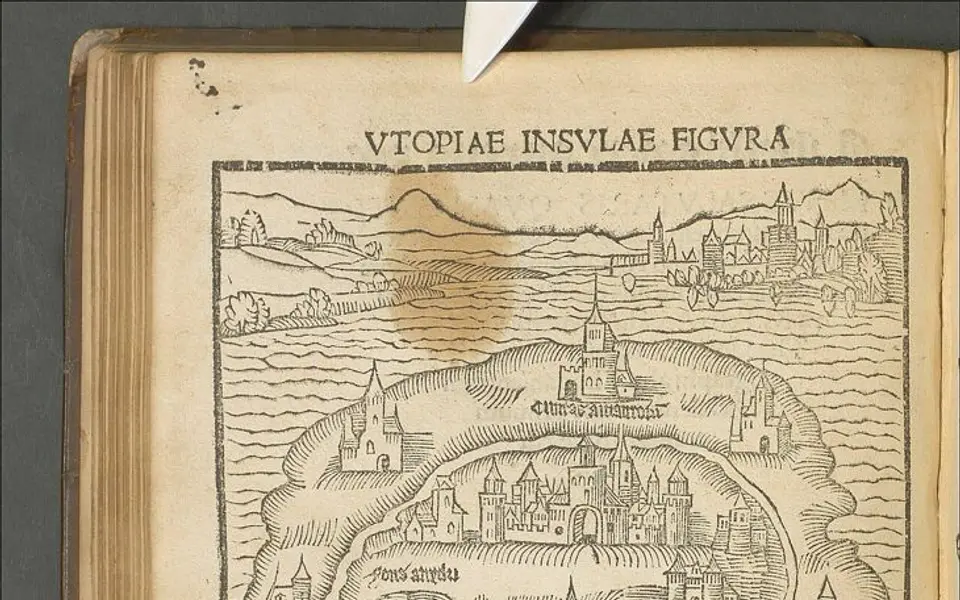
Thomas More coined the word in 1516 for an imaginary island, from the Greek for "not" and "place." Its river is called Nowater, and the traveler who describes it is named for nonsense.
In 1516 a small book in Latin was printed in Leuven, edited by the scholar Erasmus. Its full title called it a golden little book, "no less beneficial than entertaining," on the best state of a commonwealth and the new island of Utopia. The author was Thomas More, an English lawyer, who had started it the year before while serving as an envoy in the Low Countries.
More built the island's name from Greek: ou, "not," and topos, "place." Utopia means nowhere. His first choice had been Nusquama, the Latin word for nowhere.
The other names keep up the joke. Utopia's river is the Anydrus, "Nowater." Other places in the book include Achora, "Nolandia," and the land of the Polyleritae, "Muchnonsense." The traveler who describes Utopia, Raphael Hythlodaeus, has a surname that means something like "dispenser of nonsense."
The book plays it straight all the same. It opens with letters between real people: More, Peter Gilles, the town clerk of Antwerp, and Hieronymus van Busleyden, a counselor to Charles V. More chose those letters to make his island more believable. The first edition also carried a woodcut map of the island and a Utopian alphabet, with a sample of Utopian poetry.
"Muscle" comes from a Latin word meaning what?
WhyA flexed biceps looks like the back of a mouse, so Latin called a muscle musculus, little mouse. Greek made the same leap: its word mȳs means both mouse and muscle. Mussel comes from the same Latin word.
The letters explain why no one else has been there. Someone coughed, they say, just as the island's exact longitude and latitude were being announced.
More played on a second Greek word too. Eu-topos means "good place," and in English the two words sound the same. In an addendum to the book he wrote, "Wherfore not Utopie, but rather rightely my name is Eutopie, a place of felicitie."
At first utopia meant any imaginary society described in detail. It now usually means an imaginary society much better than ours. Because utopia and eutopia are pronounced alike in English, the pun may have helped that change along.
Utopia was not printed in England until 1551, in an English translation. More had been executed 16 years earlier.