 TouchéGet the app
Most dictionaries trace OK to an 1839 newspaper joke
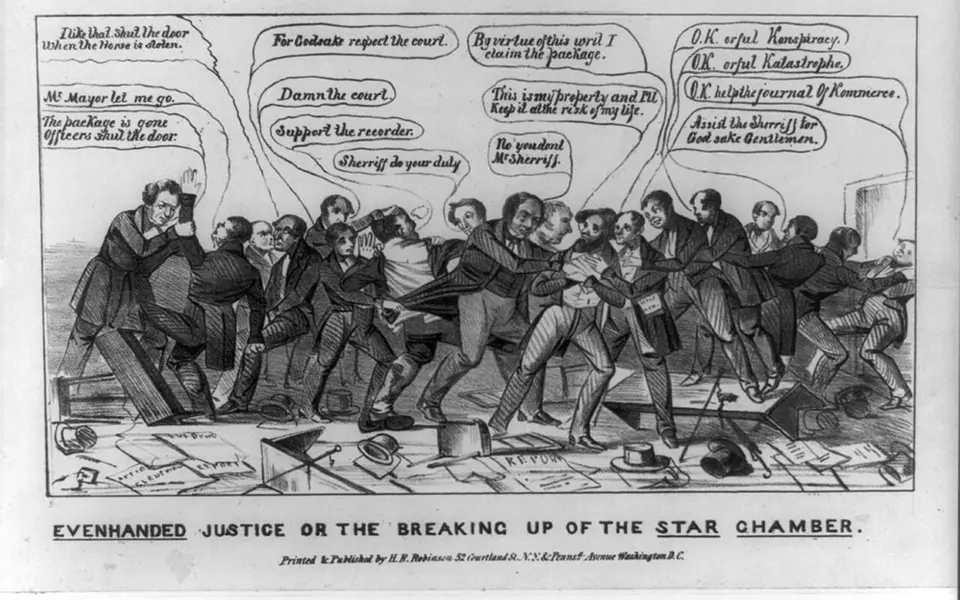
In the late 1830s Boston had a fad for abbreviating deliberately misspelled phrases, and O.K.
On March 23, 1839, the Boston Morning Post ran a teasing paragraph about the Providence Journal and a jokey club called the Anti-Bell-Ringing Society. In it Charles Gordon Greene used the letters "o.k." and explained them in the next two words: "all correct."
The letters were part of a fad that had started in Boston the summer before. People shortened phrases to their initials: OFM for "our first men," NG for "no go," GT for "gone to Texas," SP for "small potatoes." Many were deliberate misspellings, a stock joke of the humorists of the day. One forerunner was OW, "oll wright." Later printings glossed OK as "oll korrect" and even "ole kurreck."
Allen Walker Read, the etymologist who later traced all this, counted the early appearances. Seven came with an explanation. Five came with none, a sign that readers were expected to know it already.
In 1840 OK went national. President Martin Van Buren was running for a second term, and he came from Kinderhook, New York, where most people spoke Dutch. His nickname was Old Kinderhook. His Democratic supporters said that was what OK stood for, and "Vote for OK" was snappier than his Dutch name. The Whigs answered that OK came from the bad spelling of Andrew Jackson, the president before him. The publicity around the election spread the word across the United States. Van Buren lost to William Henry Harrison.
What does "a piece of cake" mean?
WhyThe phrase has been around since 1936 and began in American English. It may come from the cakewalk, a contest where the prize was a cake. If a task is a piece of cake, you can do it without effort.
Where OK came from stayed an open question. As late as 1961, three major American dictionaries, Webster's among them, gave its probable source as okeh, a word in the Choctaw language meaning "it is so." In 1825 two missionaries, Cyrus Byington and Alfred Wright, had ended many sentences with it in their Choctaw translation of the Bible.
Read made the case for Boston in six articles in the journal American Speech in 1963 and 1964, following OK from paper to paper. They answered most of the doubters, and most dictionaries now give his account. Read called the discovery "an agreeable diversion" from his main work.
Earlier sightings still came up. One was a diary written in 1815 that seemed to say "we arrived ok." Read and the scholar Frederic Cassidy tracked it to the writer's grandson, a classics professor at Duke University, and examined greatly enlarged photographs of the page. Whatever the marks were, Cassidy wrote, "they are not OK."