 TouchéGet the app
For over 300 years, a computer was a person
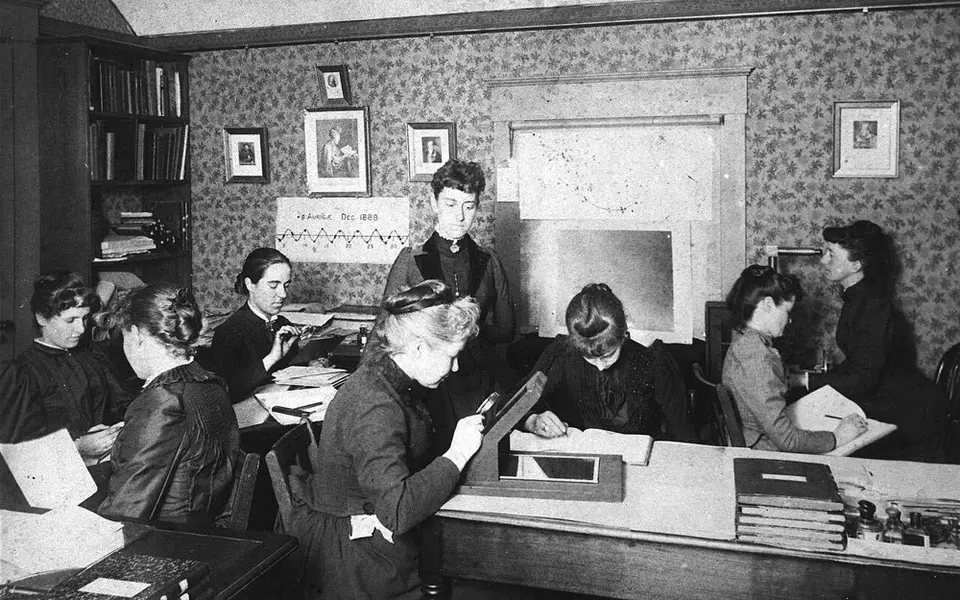
The word is first recorded in 1613, for someone who does calculations. Astronomers and navigators relied on teams of them, and from the late 1800s many were women.
In June 1757 three people in Paris set out to calculate when Halley's comet would come back. Halley himself had only been able to say the end of 1758 or the beginning of 1759, because the pull of Jupiter and Saturn would change its timing. Alexis Clairaut took the comet's orbit, while Jérôme Lalande and Nicole-Reine Lepaute calculated the pull of the two planets. They split the work, ran it in parallel and kept at it for more than six months. In November 1758 they named April 13, 1759, give or take a month. The comet passed closest to the Sun on March 13.
Lepaute was what was then called a computer. From its first known written use, in 1613, until electronic machines took over the work, a computer was a person who did calculations. Big jobs were broken into pieces so that a team could work on them at once, and the same sums were often done again by a separate team to catch mistakes.
The British Nautical Almanac, which ships navigated by, was worked out by computers. Mary Edwards, one of 35 of them, worked on it from the 1780s to 1815. At the Royal Greenwich Observatory, George Airy hired computers from 1835 who could be as young as 15. He put them in the Octagon Room with a manager, printed forms and set ways of checking each other's results, and that arrangement stayed the model for computing work for the next 80 years.
Monday is named after which celestial body?
WhyMonday comes from Old English for day of the moon. That itself was a translation of the Latin name, dies Lunae. Sunday is the Sun's day in the same way.
In 1879 Edward Pickering, director of the Harvard College Observatory, gave part-time work to Williamina Fleming, a Scottish immigrant who had been a maid in his home. She went on to run the observatory's team of women computers and hired more than 40 of them. They measured and classified stars on glass photographic plates for 25 to 50 cents an hour, more than a factory worker earned and less than a clerk. One of them, Annie Jump Cannon, sorted the stars into the classes astronomers still use.
During World War II the Moore School at the University of Pennsylvania employed about 200 women as computers, working out artillery trajectories for the Army on desk calculators. Six of them were picked to set up problems on a new machine, ENIAC. Programming languages did not exist yet, so they learned it from its blueprints, cables and switches. The six had degrees in mathematics, but they were classed as "subprofessionals," while men with the same training were "professionals."
ENIAC's full name was the Electronic Numerical Integrator and Computer. As of 2020, three of the US Army's supercomputers were called Jean, Kay and Betty, after three of the six.