 TouchéGet the app
Gerrymander began with a hard G, the way Gerry said it
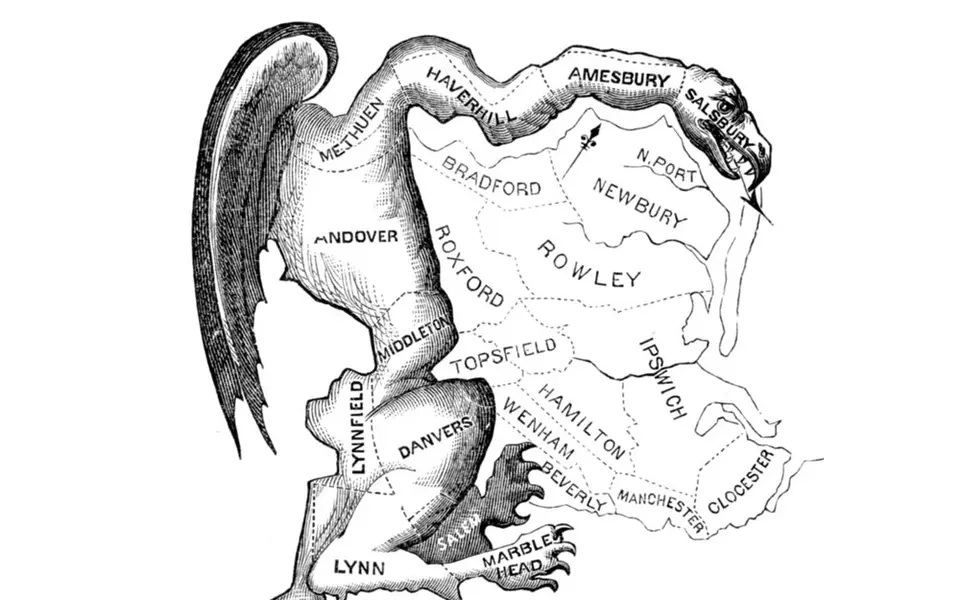
In 1812 Governor Elbridge Gerry of Massachusetts signed a bill redrawing the state senate districts to help his party, though his son-in-law said he found it "highly disagreeable." A Boston paper decided one district looked like a salamander and named it after him.
In 1812 the Massachusetts legislature redrew the districts for the state senate. The Democratic-Republicans controlled it, and they drew the lines to help their own party, which left some districts oddly shaped. Governor Elbridge Gerry, a Democratic-Republican, signed the bill. According to his son-in-law, he found it "highly disagreeable."
One of the new senate districts, in Essex County, reminded a Federalist newspaper of a salamander. On March 26, 1812, the Boston Gazette printed the word Gerry-mander, half governor and half salamander, along with a cartoon of the district as a beast with claws, wings and a dragon's head.
The cartoon was most likely drawn by Elkanah Tisdale, a Boston painter and engraver, and the woodblocks it was printed from are kept at the Library of Congress. Who coined the word is less certain. It is usually credited to the Federalist editors Nathan Hale and Benjamin and John Russell, but no record shows who said it first.
For Gerry's party, the redistricting was a success. In that year's elections the Federalists won the state house by a wide margin, and Gerry lost the governorship to Caleb Strong, partly over the redistricting. The state senate stayed firmly Democratic-Republican.
Which word completes "don't count your chickens before they ___"?
WhyA version of this advice appears in print in 1570, in a poem by Thomas Howell. It warns you not to plan around something that hasn't happened yet. The eggs may never hatch.
Later that year the Democratic-Republicans nominated Gerry for vice president, and he was elected alongside James Madison. He served 21 months and died in office in 1814.
Federalist papers kept reprinting the word for the rest of 1812, in Massachusetts, across New England and around the country. It was soon applied to oddly shaped districts in other states. According to the Oxford English Dictionary, it reached a dictionary in 1848 and an encyclopedia in 1868.
Gerry's name is said with a hard G, as in get, and gerrymander was first said the same way. The soft G, as in gentle, has since taken over. In Marblehead, the town where Gerry was born, people still use the original.