 TouchéGet the app
They blamed pigeons for the faint glow left by the Big Bang
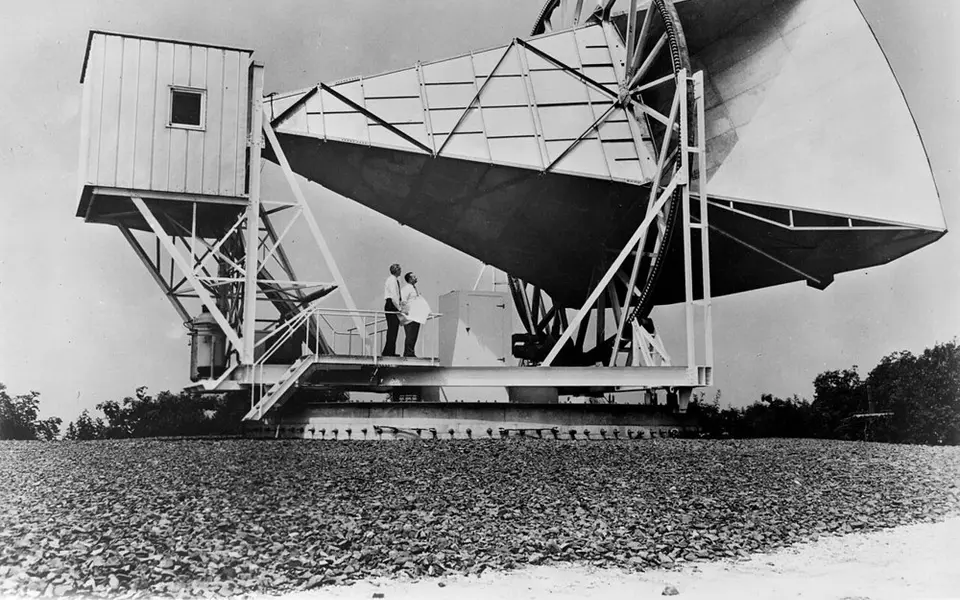
In 1964 Arno Penzias and Robert Wilson found a faint, steady noise in a big horn antenna in New Jersey. It came from every direction, day and night.
In 1964 two radio astronomers at Bell Telephone Laboratories, Arno Penzias and Robert Wilson, were working with a horn antenna on Crawford Hill in Holmdel, New Jersey. It had been built in 1959 for Project Echo, which bounced radio signals off huge metal-coated plastic balloons in orbit. The two wanted to measure very faint radio waves from space, so they had to get rid of every other source of noise.
They removed the effects of radar and radio broadcasts. They cooled the receiver with liquid helium to about 4 degrees above absolute zero, so that its own heat would not add noise. A low, steady noise remained. It was about 100 times stronger than they had expected, it came evenly from all over the sky, and it was there day and night.
They worked through the possible causes. They considered New York City and ruled it out. They checked the equipment. Pigeons had been nesting inside the horn, and it was full of their droppings, which Penzias described as "white dielectric material." They removed the pigeons and cleaned out the droppings. The noise was still there.
About 37 miles away, at Princeton University, Robert Dicke, Jim Peebles and David Wilkinson were preparing to search for a signal of this kind. They reasoned that if the universe began in a Big Bang, it was once filled with a hot, dense fog. As it expanded and cooled, atoms formed, the fog cleared, and the light trapped in it was set free. The continuing expansion of the universe has stretched that light out so far that it should now arrive as faint microwaves, from every direction at once.
Which bone is known as the thigh bone?
WhyYour thigh bone is about a quarter of your height, and that holds for almost everyone. The ratio is steady enough that scientists can estimate how tall a person was from a single femur.
Penzias heard about the Princeton work from a friend, the MIT physicist Bernard Burke, who had seen a draft paper by Peebles. Penzias phoned Dicke. After that call, Dicke said, "Boys, we've been scooped." Penzias invited him to Bell Labs to look at the antenna and listen to the noise, and the two groups agreed that it was the radiation Princeton had predicted.
They published side by side in the Astrophysical Journal Letters. Dicke's group explained what the radiation meant for the Big Bang. Penzias and Wilson titled their paper "A Measurement of Excess Antenna Temperature at 4080 Megacycles per Second," and pointed to Dicke's letter for a "possible explanation."
In 1978 Penzias and Wilson won the Nobel Prize in Physics. Peebles won one in 2019, for his work on the theory of the universe's history.
The receiver went to the Deutsches Museum in Munich, Penzias's birth city, in 1992. The antenna stayed on Crawford Hill. In January 2024 Holmdel Township completed its purchase of the antenna and 35 acres around it, to turn into a public park.