 TouchéGet the app
In 1851 a pendulum let Parisians watch the Earth turn
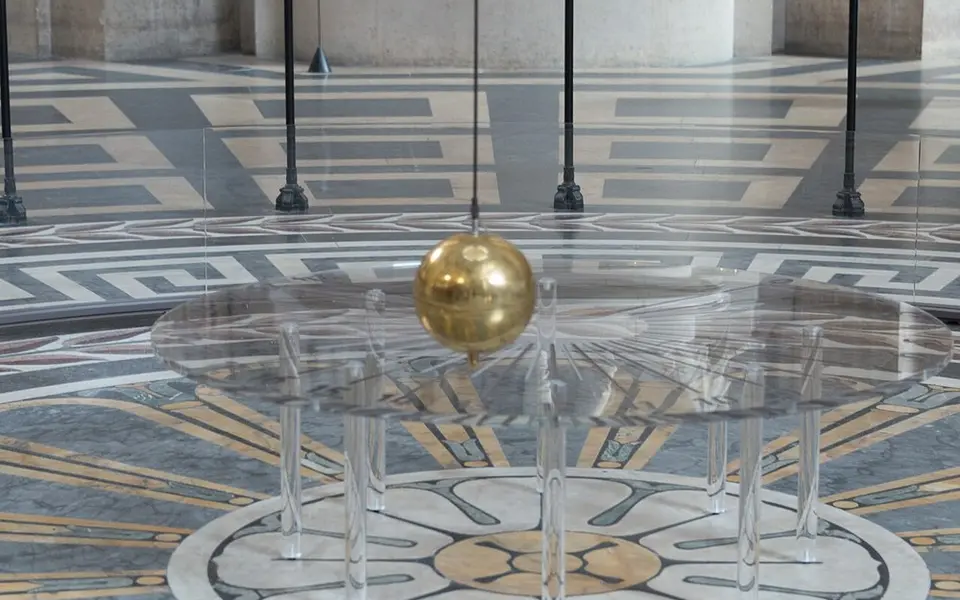
Léon Foucault hung a 62-pound ball on a 220-foot wire from the dome of the Panthéon in Paris. Its swing slowly turned, about 11 degrees an hour.
In February 1851 Léon Foucault showed a pendulum at the Paris Observatory. Foucault had studied medicine and given it up for physics, because he could not stand the sight of blood. A few weeks later he hung a much bigger pendulum from the dome of the Panthéon: a brass-coated lead ball weighing 62 pounds, on a wire 220 feet long. Set swinging, it traced a line back and forth across the floor. Over the hours that line slowly turned clockwise, about 11 degrees an hour.
Nothing was pushing the ball sideways. A swinging pendulum keeps to the same plane unless something forces it out. Foucault had got the idea from a lathe: a thin rod held in it kept vibrating in the same plane while the lathe turned. The people watching in the Panthéon were standing on the thing that moved. The floor was turning under the swing, carried round by the Earth.
In his paper on the experiment, published in 1851, Foucault started with the simplest place, the North Pole. There, he wrote, the plane of the swing keeps a fixed position in space while the Earth turns from west to east underneath it. Seen from the ground, the swing would make a full circle in 24 hours.
What is pure water's pH considered?
WhyPure water sits right in the middle of the pH scale, neither acidic nor basic. Add lemon juice and it tips acidic; add baking soda and it tips basic. Most tap water is close to neutral but not perfectly so.
Anywhere else it is slower. At the equator the swing does not turn at all. In between, it turns more slowly the closer the pendulum is to the equator. Paris lies about halfway between the two, and there a full circle takes about 31 hours and 50 minutes.
Vincenzo Viviani, a student of Galileo, had seen a pendulum's swing veer like this in 1661, but he treated it as a nuisance and never tied it to the Earth's rotation. Foucault's demonstration caused a sensation among scientists and ordinary people alike. Foucault pendulums were hung in major cities across Europe and America, and they drew crowds. The next year Foucault proved the Earth's rotation a second way, with a spinning wheel he named the gyroscope.
In 1855 the original ball was moved to the Conservatoire des Arts et Métiers, a museum in Paris. On April 6, 2010, the cable holding it there snapped. The ball hit the marble floor, and both were damaged beyond repair. The damaged ball now sits in a case beside the pendulum that replaced it. Under the dome of the Panthéon, an exact copy of the original has been swinging since 1995.