 TouchéGet the app
Congress once set aside money to paint the Statue of Liberty
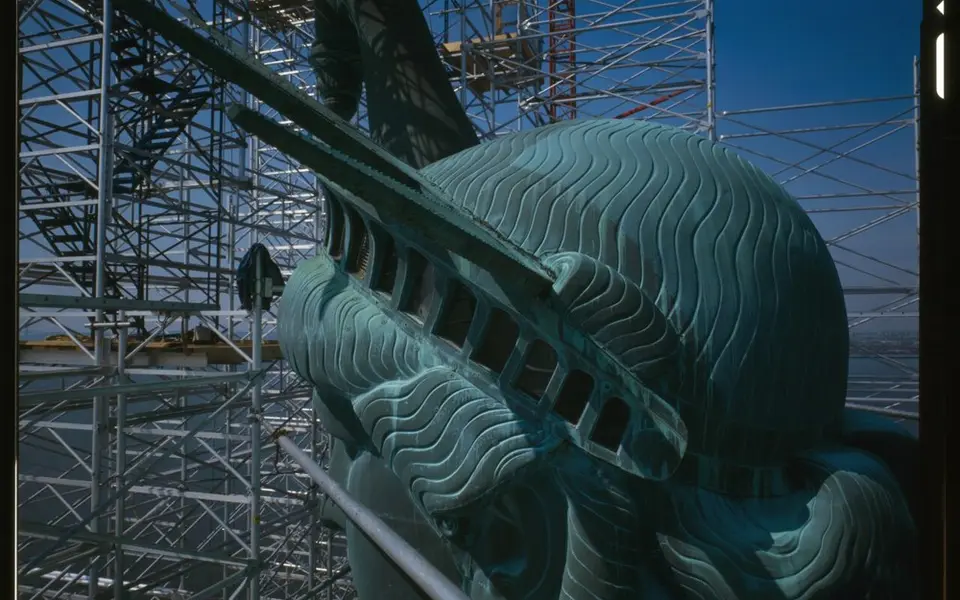
The Statue of Liberty was copper-colored when it was dedicated in 1886.
When the Statue of Liberty was dedicated in New York Harbor in 1886, it was the reddish brown of new copper. Its skin is copper sheet about three thirty-seconds of an inch thick, hammered into shape. The sculptor, Frédéric Auguste Bartholdi, chose copper over bronze or stone because it cost less and weighed less, and it was easier to ship.
Shortly after 1900 a green layer began to spread over it. Newspapers mentioned it as early as 1902, and by 1906 it covered the whole statue. Congress took the green to mean the statue was corroding. It set aside $62,800 for repairs, including painting the statue inside and out.
There was a public outcry against painting the outside. The Army Corps of Engineers studied the green layer and concluded that it protected the copper skin. It had also, the engineers wrote, "softened the outlines of the Statue and made it beautiful." Only the inside was painted.
The green is verdigris. Copper reacts slowly with the air, with water and with acid pollution, and the products form a crust on the surface. Rust on iron does not protect the metal underneath. This crust does, so the copper below it corrodes no further. The same green covers many old copper roofs.
What is the chemical formula for carbon dioxide?
WhyCO2 means one carbon atom bonded to two oxygen atoms. It is what you exhale, what plants absorb, and what makes soda fizzy. CO, missing one oxygen, is carbon monoxide, a dangerous gas in its own right.
The corrosion that mattered was on the inside. The copper skin hangs on an iron frame designed by Gustave Eiffel. When two different metals touch with moisture around them, one of them corrodes. Chemists call this galvanic corrosion, after Luigi Galvani. The builders knew it, and they separated the copper from the iron with a layer of asbestos soaked in shellac.
Over the decades that layer failed, and the iron frame rusted. The paint added to the inside over the years hid much of the damage. Checks in the 1980s found the frame badly corroded.
In 1984 the statue closed for restoration. Workers used liquid nitrogen to strip the layers of paint from the inside of the skin, and then blasted off two layers of coal tar underneath with baking soda, which did not harm the copper. They replaced Eiffel's entire iron frame with stainless steel bars. Larger holes in the skin were patched with new copper.
That copper came from a roof at Bell Labs, where it had weathered to a green close to the statue's own. In exchange, Bell Labs got some of the statue's old copper to test.