 TouchéGet the app
The first stethoscope was a few sheets of paper, rolled up
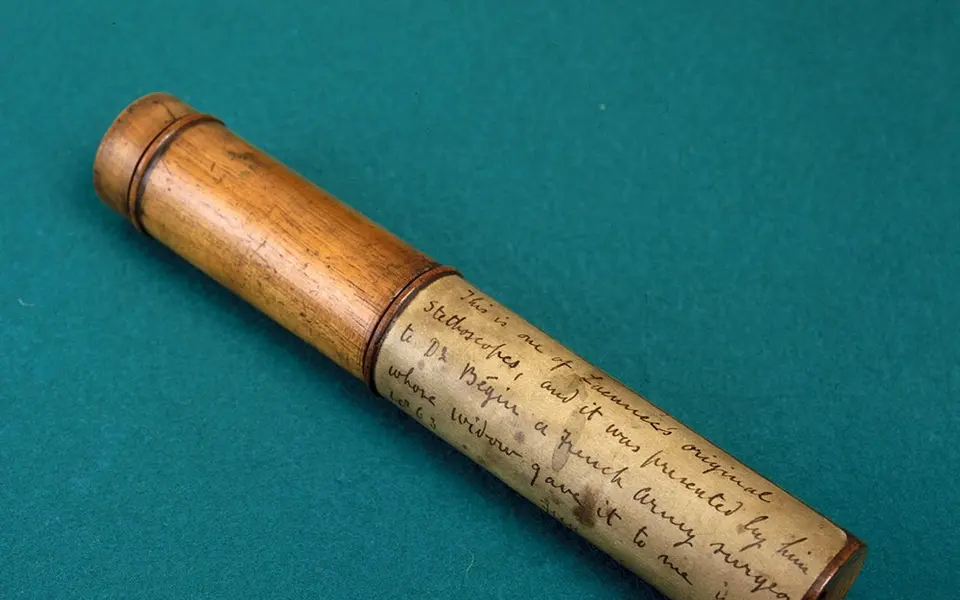
In 1816 the Paris doctor René Laennec needed to hear a young woman's heart, and putting his ear to her chest was out of the question.
In 1816 René Laennec, a doctor at the Necker hospital in Paris, was called to see a young woman with the signs of heart disease. The usual checks told him little. Tapping her chest and feeling it with his hand did not work well, because she was heavyset. The other method doctors used, pressing an ear straight onto the patient's chest, was ruled out by her age and sex.
Laennec described what he did next in his book. He remembered a simple fact of acoustics: with your ear at one end of a piece of wood, you can clearly hear a pin scratching the other end. He rolled a stack of paper into a tube, put one end over her heart and the other to his ear. He was "not a little surprised and pleased," he wrote, to hear her heart more clearly than he ever had with his ear against a chest.
Laennec carved his own wooden flutes, and he soon made the tube out of wood. His first instrument was a hollow wooden tube about 10 inches long and an inch wide. He later made it in three parts that came apart, with a funnel-shaped opening to gather the sound. He called it "the cylinder." Its formal name, stethoscope, came from the Greek words for chest and examination.
At the hospital he could follow chest patients from the bedside to the autopsy table, so he could match the sounds he had heard in a living patient with what was found in the lungs and heart afterward. That let him tell diseases such as tuberculosis apart by sound. Some of the names he gave to those sounds, such as rales and rhonchi, are still used by doctors in ordinary examinations. In 1819 he published his findings as a book, On Mediate Auscultation.
What is a substance made of one type of atom called?
WhyAn element cannot be broken down into anything simpler by ordinary chemical means. Gold, oxygen and carbon are all elements on their own. Combine two or more elements chemically and you get a compound instead.
The book was translated and spread through France, England, Italy and Germany in the early 1820s. Not every doctor was won over. As late as 1885, a professor of medicine said, "He that hath ears to hear, let him use his ears and not a stethoscope." L. A. Connor, who helped found the American Heart Association, carried a silk handkerchief to lay on a patient's chest and listened with his ear.
Laennec died of tuberculosis in 1826, at 45. He left his own stethoscope to his nephew.
His version had one earpiece. In 1851 the Irish physician Arthur Leared invented a stethoscope for both ears, and the next year George Cammann, a doctor in New York City, refined the design for commercial production. Cammann's design, with a tube to each ear, is still the basic form of the stethoscope.