 TouchéGet the app
Theodore Roosevelt's order to write "tho" lasted four months
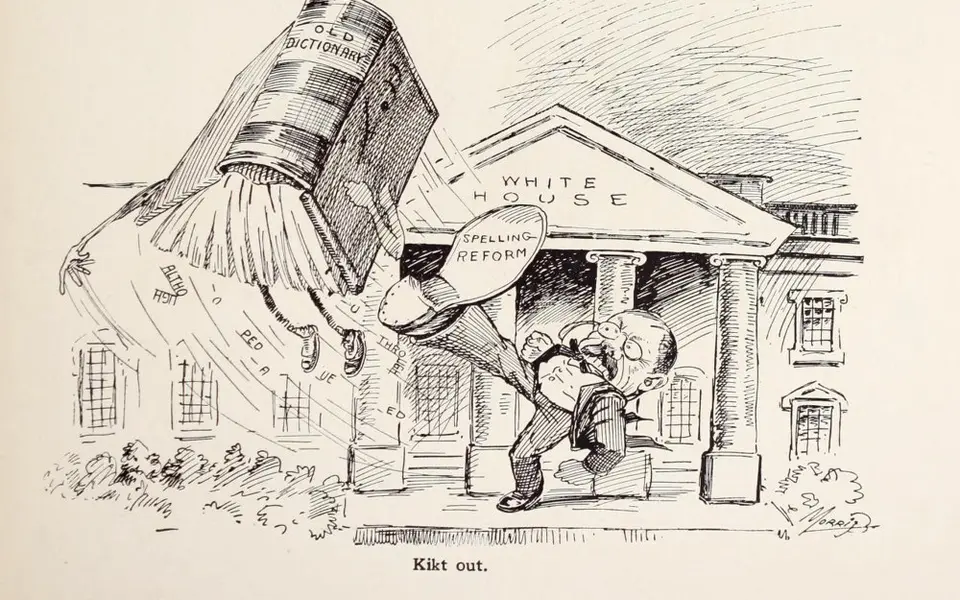
In August 1906 the president told the Government Printing Office to use 300 simplified spellings, such as "tho" and "wisht." Newspapers on both sides of the Atlantic mocked him, and the Supreme Court kept printing its opinions the old way.
On March 11, 1906, a new group called the Simplified Spelling Board was announced in New York, with Andrew Carnegie paying for it. Carnegie believed English could become the world's language and help keep the peace, if its spelling were not so contradictory and difficult.
The board's chairman, Professor Brander Matthews, summed up the plan as "simplification by omission": drop the letters nobody needed. On April 1 the board published its first list of 300 words. Addressed became addrest, missed became mist, and wished became wisht. Catalogue lost its last two letters, and though, although and thorough became tho, altho and thoro. More than half of the new spellings were already preferred by Webster's dictionary, the board pointed out.
In August President Theodore Roosevelt, at his home in Oyster Bay, New York, signed an order to use the new spellings in his official messages. He told the Public Printer to use them in all federal documents too. Matthews had not been told in advance and heard about it when the order came out. The printers obeyed, and one of the documents printed the new way was the president's special message on the Panama Canal.
The press on both sides of the Atlantic had fun with it. The Louisville Courier-Journal wrote, "Nuthing escapes Mr. Rucevelt. No subject is tu hi fr him to takl." The Baltimore Sun wondered how he would spell his own name, and offered "Butt-in-sky." The Supreme Court directed that its opinions be printed in the old style.
Sideburns are named after which Civil War general?
WhyUnion general Ambrose Burnside wore thick side whiskers joined by a mustache, with a clean-shaven chin. The style was called burnsides after him. In the 19th century the word got flipped around to sideburns.
On December 13, 1906, Representative Charles B. Landis of Indiana, who chaired the House Committee on Printing, moved that government printing follow the spelling of generally accepted dictionaries. The House passed it unanimously, and Roosevelt withdrew his order.
Matthews, a friend of the president, protested. On December 16 Roosevelt wrote back that he could not have kept the new spelling in by fighting, and that once he was beaten an undignified contest would have been "worse than useless." He also named the one new spelling he had thought was wrong, the word that had done more than any other to sink them: thru.
The next summer Roosevelt was watching a naval review when a press boat went by marked "Pres Bot." He waved and laughed.
Carnegie lost patience with the board too. In 1915 he complained that it had tried radical changes instead of pushing a dozen words, and wrote, in his own reformed spelling, "I think I hav been patient long enuf." When he died in 1919 his will left the board nothing, and it shut down in 1920. Some of its spellings did take hold in American English, among them anemia and mold.