 TouchéGet the app
Rule of thumb was tied to wife-beating only in the 1970s
The phrase is in print by the 1680s, meaning a rough practical method.
The phrase is first found in print in 1685, in a collection of sermons by the Scottish preacher James Durham, published after his death. Some Christians, he wrote, were like foolish builders, who build "by guess, and by rule of thumb (as we use to speak), and not by Square and Rule." A fencing manual of 1692 set rule of thumb against art in the same way.
Nobody knows exactly where the thumb comes from. In the cloth trade the width of a thumb served as an inch, and brewers used a thumb to judge the heat of the vat. Either way, the phrase meant a rough method learned by practice.
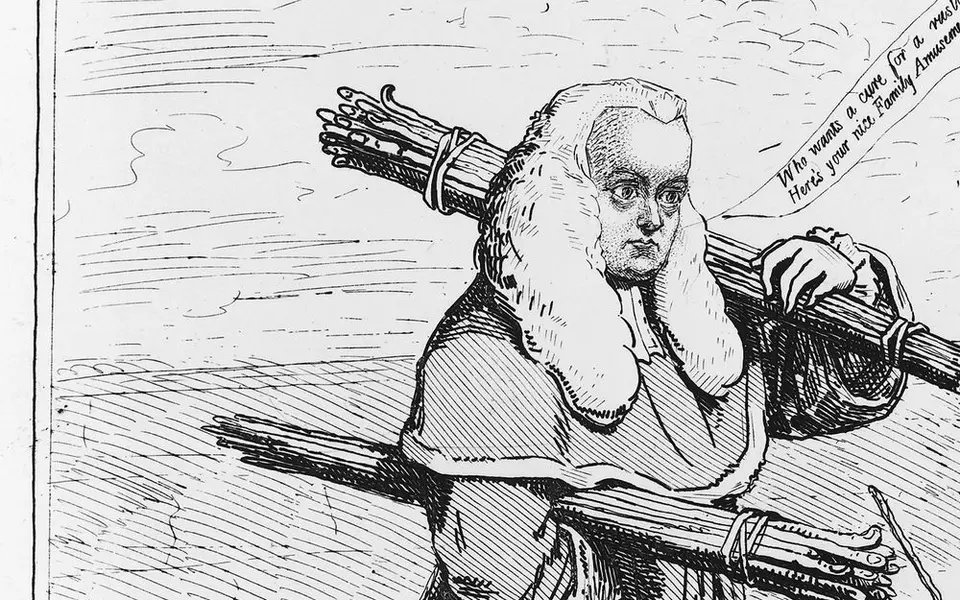
The thumb's other meaning goes back to 1782. Sir Francis Buller, a judge of the King's Bench, was rumored to have said that a husband could beat his wife as long as the stick was no wider than his thumb. There is no record that he said it. The rumor was enough to bring on jokes and cartoons calling him "Judge Thumb," among them a caricature by James Gillray that year.
English law had no such rule. William Blackstone, writing in the late 1700s, described an "old law" under which a husband had once been allowed "moderate correction" of his wife, and said that by the late 1600s it was already in doubt. He mentioned neither thumbs nor sticks.
What does "bite off more than you can chew" mean?
WhyThe picture is of someone stuffing their mouth so full that they can't chew. The phrase means trying to do more than you can handle. A person who overcommits is said to have done it.
In the 1800s the thumb did turn up in several American court rulings. In 1824 a Mississippi court said a husband could discipline his wife with a whip or stick no wider than the judge's thumb. In 1873 a North Carolina court called that an "old doctrine" and said it was not the law in that state. None of these rulings called it a rule of thumb.
The phrase and the story first met in 1976, in a report on domestic violence by the women's-rights advocate Del Martin. Describing the supposed old doctrine of a switch no bigger than a thumb, she added, "a rule of thumb, so to speak." She seems to have meant it only as a turn of phrase. The next year a book on battered women described the "rule of thumb" as a section of British common law.
Law journals repeated it, and in 1982 the US Commission on Civil Rights titled a report on domestic violence "Under the Rule of Thumb." Some people tried to discourage the phrase because of it. In the 1990s several writers, among them the English professor Henry Ansgar Kelly, showed that the story was false. It still appeared in some legal sources into the early 2000s.