 TouchéGet the app
The rules of a 4,500-year-old board game survived on clay
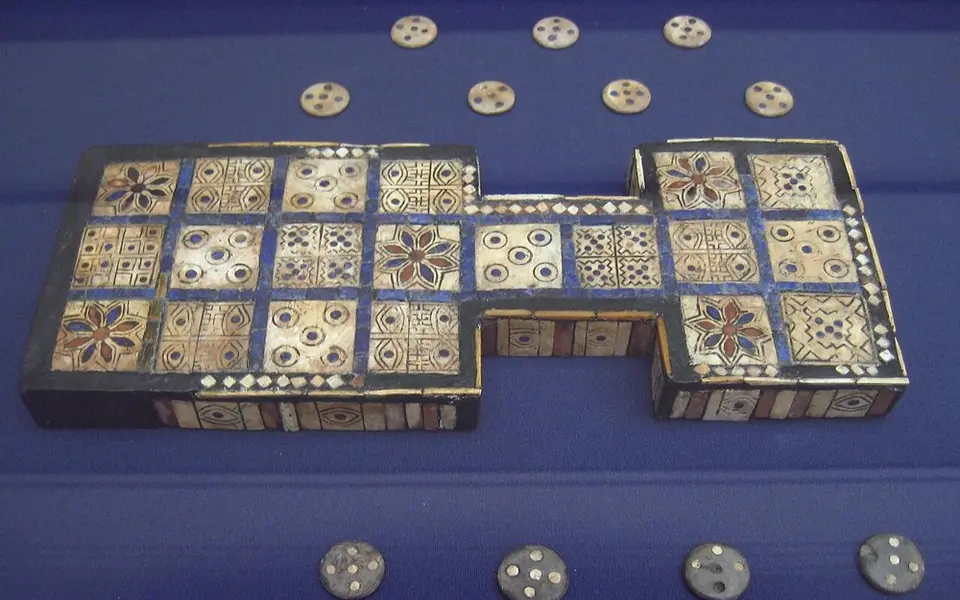
In the 1920s and 1930s archaeologists dug up boards for the Royal Game of Ur, but nobody knew how to play it.
Between 1922 and 1934 the British archaeologist Leonard Woolley excavated the Royal Cemetery at Ur, in what is now southern Iraq. Among the finds were five game boards made around 2600 to 2400 BC. Each had 20 squares in an odd layout: a block of twelve and a block of six, joined by a narrow bridge of two. Some were simple, with discs of shell set into the wood. One was covered in shell plaques inlaid with red limestone and lapis lazuli.
Because of where they were found, the game became known as the Royal Game of Ur. Boards for it later turned up across the Middle East and as far away as Crete and Sri Lanka. Four similar ones were buried with Tutankhamun. Someone scratched one, possibly with a dagger, onto a stone guardian figure at the gate of Sargon II's palace in Khorsabad. Nobody knew the rules.
The rules were on a clay tablet found in 1880 in the ruins of Babylon and sold to the British Museum. A scribe named Itti-Marduk-balatu had written it around 177 BC, working from an older description of the game by another scribe. On its back was a drawing of the board. In the early 1980s Irving Finkel, a curator who reads cuneiform, translated it.
The slang "pwned" began as a typo of which word?
WhyThe O and P keys sit side by side on a QWERTY keyboard, and somebody mistyped "own." The slip stuck as a taunt for an opponent who has just been soundly beaten.
He also used photographs of a second tablet, probably centuries older, which had belonged to a private collector and was destroyed during World War I. From the two texts and the shape of the board, he worked out how the game was probably played. Each player races seven pieces along a course and off the board. Moves are set by four-sided dice, each with two of its four tips marked, and you count the marked tips that land facing up. The eight middle squares are shared, and landing on an opponent there sends that piece back to the start. A piece on the central rosette is safe, and landing on any rosette earns another throw.
The tablet also shows what the game meant to the people who played it. Landing on certain squares came with predictions: "You will find a friend," "You will become powerful like a lion," "You will draw fine beer." It describes betting too. Skip a rosette and you put a token in the pot. Land on one and you take a token out.
Across the Middle East the game faded away in late antiquity, possibly turning into, or being pushed aside by, early forms of backgammon. One community kept playing. The Jews of Kochi, in southern India, played a version they called Aasha, with 20 squares and 12 pieces each. They were still playing it when they began emigrating to Israel in the 1950s.