 TouchéGet the app
Lab bosses at MIT played a maze game and tried to stop it
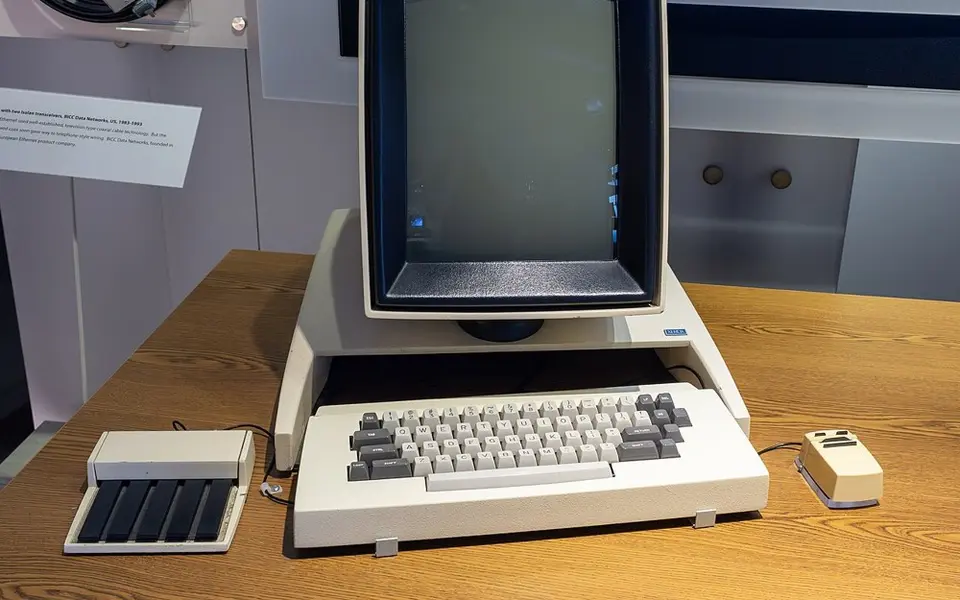
In 1973 three high school students in a NASA work-study program made Maze, a game in which players walk a 3D maze and shoot each other.
In 1973 three high school students, Steve Colley, Greg Thompson and Howard Palmer, were in a work-study program at NASA's Ames Research Center in California. Their job was helping to draw pictures of fluid flow on Imlac PDS-1 minicomputers, which had screens that could draw lines. Colley wrote a program that rotated a cube on the screen and made it look solid by leaving out the edges that should be hidden. The three wondered what they could do with it for fun.
Palmer suggested a maze you could walk through. To keep it simple, the maze was built of cubes and you could face only four ways. Colley came back the next day with a working version. Palmer and Thompson linked two of the computers with a cable so two people could play at once, then added the ability to shoot each other. Colley added a way to peek around corners, because he found it too easy to get shot while turning.
That fall Thompson went to MIT, and in February 1974 he brought the game along on paper tape. At the lab called Project MAC, he and Dave Lebling, who later helped write Zork, rebuilt it around the lab's big PDP-10 computer, which was wired to eight terminals. Up to eight players could now share one maze, each shown to the others as a three-letter user name. Lebling added computer-controlled players for when people were short, and slowed them down once they had scored enough, because some players found them too hard.
Donkey Kong was first planned around which cartoon characters?
WhyMiyamoto wanted Popeye, Bluto and Olive Oyl, but Nintendo could not get the license. So he made Jumpman, Donkey Kong and Pauline instead. Nintendo did not land the Popeye rights until 1982.
Students opened accounts on the system just to play. Terminals had to be booked, so some players came in the middle of the night. According to Lebling, the game ran almost constantly outside working hours. The lab was paid for by DARPA, the Defense Department's research agency, for serious work. So its director, J. C. R. Licklider, and his deputy, Al Vezza, tried to limit the game, although both of them played it. At Vezza's request, Lebling wrote a program called the Maze Guncher that ran in the background and crashed any game in progress. Players found ways around it, or switched it off. The system had no security to stop them.
The lab was also on the ARPANET, and Maze spread to other universities with the same terminals. Lebling recalled that the first game between two institutions pitted MIT against the University of California, Santa Cruz. The network was slow, and the players far from MIT were at a disadvantage until the code was changed to allow for the delay. It was later reported that DARPA at one point banned the game from the network, because half the traffic between Stanford and MIT was Maze.
In 1977 Jim Guyton of Xerox's research center in Palo Alto and Mike Wahrman of the RAND Corporation rewrote the game for Xerox's Alto computers. Altos could talk to each other directly over a new kind of network, Ethernet. The other players now appeared as a large eyeball, drawn by a colleague, Bill Verplank. The game was an immediate hit around the office, and within a few weeks it had spread to other Xerox sites.