 TouchéGet the app
The Royal Navy poured its sailors rum every day until 1970
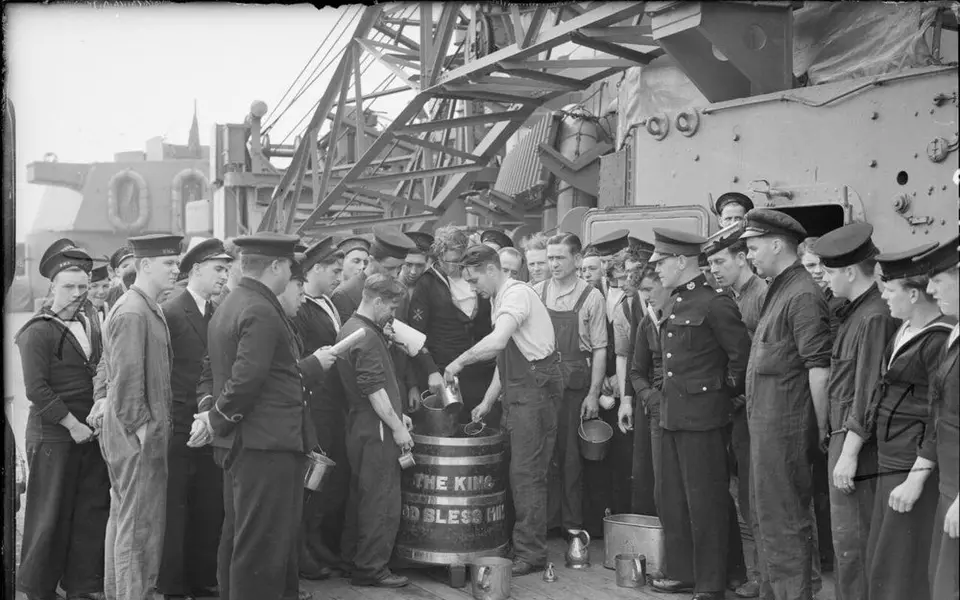
Until 1970, every Royal Navy sailor aged 20 or older could draw a daily tot of rum, poured out before noon after the call "Up Spirits." Parliament had discussed ending it twice in the 1800s, and nothing came of it.
Every morning between 11 and noon, a bosun's mate on a Royal Navy ship piped "Up Spirits." The sailors had their own reply: "Stand fast the Holy Ghost." Rum burns easily, so it was kept in a locked store deep in the ship. It was brought up and measured out, one tot for every sailor aged 20 or over.
A tot was an eighth of a pint of rum at 54.6 percent alcohol. Petty officers drank theirs neat, and junior sailors got theirs mixed with water. A sailor could have himself marked in the ship's books as T, for temperance, and take threepence a day instead, but most preferred the rum. The tot glasses were washed on the outside and never inside, in the belief that what clung to the glass made the next tot stronger.
The navy's drink had once been beer, a gallon a day per man, often weak. It gave way to half a pint of spirits, and in the West Indies that meant rum. In 1740, to cut down on drunkenness and discipline problems, Edward Vernon, commanding the British squadron in the West Indies, ordered its rum mixed with four parts water and served in two halves, one before noon and one after the working day. Watered rum also spoiled faster, so sailors could not save it up.
Vernon wore a coat of grogram cloth, and his sailors called him Old Grog. The watered rum became grog. A story that he also added lime juice to prevent scurvy comes from a misreading of his order. It only said that thrifty sailors could buy sugar and limes to make the drink taste better.
A bread knife has what kind of edge?
WhyThe teeth touch the loaf at only a few small points, which raises the pressure at each one. That is how they break through a firm crust without crushing the soft crumb.
The ration was halved in 1824 and halved again in 1850, to the eighth of a pint it stayed at. Parliament discussed abolishing it in 1850 and in 1881. Nothing came of either.
In December 1969 the Admiralty Board told Parliament that the rum issue no longer fit a navy whose sailors worked with "complex, and often delicate, machinery and systems" on which lives might depend. The admiral who ended it, Peter Hill-Norton, also worried about sailors failing a breath test. On the evening of January 28, 1970, the House of Commons debated the question for an hour and 15 minutes. The Great Rum Debate closed at 10:29 p.m., and the ration was finished.
The last tot was poured on July 31, 1970, at 11 a.m. as usual. Some sailors wore black armbands. Tots and rum tubs were buried at sea. At HMS Collingwood, a navy training base in Hampshire, there was a mock funeral with a black coffin, drummers and a piper. The day became known as Black Tot Day. Each sailor got an extra can of beer a day instead.
One order survived. "Splice the mainbrace" still awards sailors an extra tot for good service, and only the monarch can give it. The Royal Canadian Navy ended its daily ration in 1972. New Zealand's navy held out until February 28, 1990, the last navy to issue rum every day.