 TouchéGet the app
A stone pineapple 46 feet tall sits on a Scottish hothouse
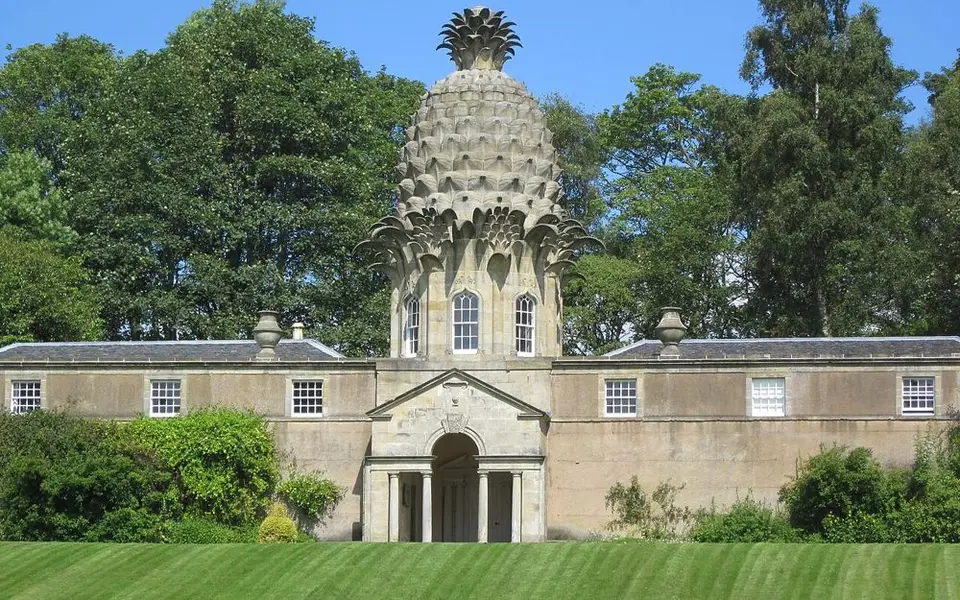
In 18th-century Britain, growing a pineapple took a heated glasshouse and a great deal of labor, so the fruit became a status symbol.
On an estate near Airth, in central Scotland, a long garden wall rises in the middle into a stone pineapple about 46 feet tall. Each of its carved leaves is drained separately, so that rainwater cannot collect in the stone and freeze. In 1995 it was ranked the most bizarre building in Scotland.
It belonged to John Murray, 4th Earl of Dunmore. In 1761 he built a hothouse into the north wall of his walled garden, where its glass front faced south into the sun. A furnace sent hot air through cavities in the walls, and the smoke went out through four chimneys disguised as Grecian urns. The hothouse was used, among other things, to grow pineapples.
In Britain that took a lot of effort. Columbus had first met the fruit on Guadeloupe in 1493, and for nearly two centuries nobody in Europe could grow it. Dutch growers managed it first, in greenhouses near Leiden, and plants reached English gardeners early in the 1700s. Some growers used pineapple pits, glass-covered trenches kept warm by 15 metric tons of fresh horse manure as it rotted.
The cost of importing pineapples, or of growing them, made the fruit a symbol of wealth. At first they were used mainly for display at dinner parties, and the same pineapple came back to the table again and again until it began to rot. Growing them on British estates became a rivalry among rich aristocrats.
Which plant do green, black and oolong teas all come from?
WhyWhat separates them is how far the leaves are allowed to oxidize. Green tea is unoxidized, oolong is partly oxidized, and black tea is fully oxidized, which is why Chinese calls black tea "red tea."
Dunmore left Scotland after the hothouse was built. He became governor of New York in 1770 and of Virginia in 1771, the last royal governor Virginia had. In 1776, during the American Revolution, he fled, and he later returned to Britain.
The arch under the pineapple is carved with the date 1761, but there is no clear evidence that the pineapple went up at the same time. It may have been added after Dunmore came home from America. Nobody knows for certain who designed it. It is often credited to Sir William Chambers, who designed similar fanciful buildings at Kew Gardens.
Under the pineapple is a small round room. Its walls are curved, and so are the door and the glass in its seven windows. It is just big enough for a round table and some chairs. The gardeners lived in two small cottages built on either side of it.
The Dunmore family kept the estate until 1970, when it was broken up and sold in lots. The Countess of Perth bought the lot with the pineapple and gave it to the National Trust for Scotland in 1974. The Landmark Trust restored the building and turned it into holiday accommodation.