 TouchéGet the app
In 1833 Boston sent a shipload of pond ice to Calcutta
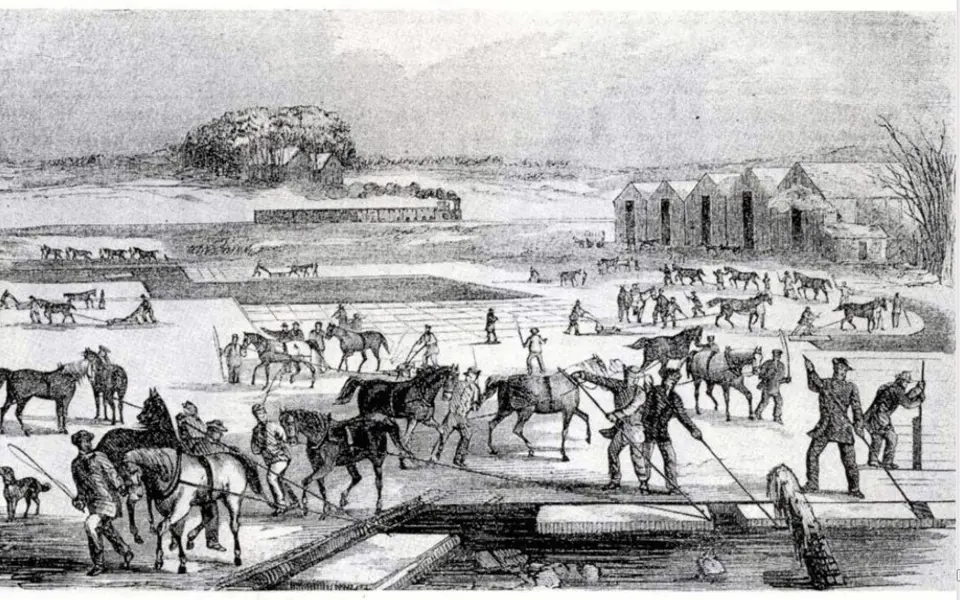
In 1806 Frederic Tudor of Boston began cutting ice from New England ponds and shipping it to the tropics.
On February 10, 1806, a brig named Favorite set out from Charlestown, Massachusetts, for the Caribbean island of Martinique with a cargo of ice. The Boston Gazette began its report "No joke" and hoped the venture would not prove "a slippery speculation."
The ice belonged to Frederic Tudor, the son of a wealthy Boston lawyer. In New England, ice was a luxury for the rich, cut from ponds on their estates in winter and kept in ice houses. Tudor planned to sell it as a luxury in the West Indies and the American South, and to get monopolies so that nobody could undercut him. The business community thought him eccentric at best and a fool at worst.
Much of the ice melted on the three-week voyage, and Martinique had nowhere to store the rest. Tudor lost $4,500. Shipments to Havana the next year lost more. In 1812 and 1813 he spent time in debtors' prison, and in November 1815 he sailed for Havana "pursued by sheriffs to the very wharf."
He had borrowed $2,100 to buy ice and to build a new ice house in Havana, with double walls, that held about 150 tons. Storage was what Martinique had lacked. He learned to pack the blocks tightly, like masonry, and to insulate them with sawdust or wood shavings. Ships were cheap to hire, because many left Boston empty to pick up cargo in the West Indies, and the ice itself cost only the labor of cutting it.
A dish topped with browned cheese or crumbs is called what?
WhyGratin comes from the French gratter, "to scrape," because the browned crust had to be scraped out of the dish. The word did not appear in English until 1846, though the method is older.
The ice houses also let him beat rivals. When a competitor arrived, Tudor cut his price to a cent a pound, which lost money. The rival could sell at a loss too or watch his cargo melt. Then Tudor raised his prices again. By the mid-1820s about 3,000 tons of ice a year left Boston, two thirds of it his. In 1825 one of his suppliers, Nathaniel Wyeth, invented a horse-drawn blade that cut ice into even blocks, and the cost of harvesting at Fresh Pond in Cambridge fell from 30 cents a ton to 10.
On May 12, 1833, Tudor and two partners sent the brig Tuscany from Boston to Calcutta, about 16,000 miles and four months away, with 180 tons of ice in its hold. When it neared the Ganges in September, many people there thought the delivery was an elaborate joke. About 100 tons were still aboard, and they sold. The British community in Calcutta built a stone ice house for the shipments that followed, and Calcutta brought Tudor more than $200,000 in profit over the years.
From 1842 ice was also cut at Walden Pond. One winter while Henry David Thoreau was living there, a crew came off the train and cut ice for sixteen days. "The sweltering inhabitants of Charleston and New Orleans, of Madras and Bombay and Calcutta, drink at my well," he wrote in his journal.
Companies making artificial ice were founded in Madras in 1874 and in Bengal in 1878, and they soon drove natural ice out of the Indian market. Tudor's ice house in Madras was sold and remodeled. It is now known as the Vivekanandar Illam.