 TouchéGet the app
The oldest known recording of a song was made to be read
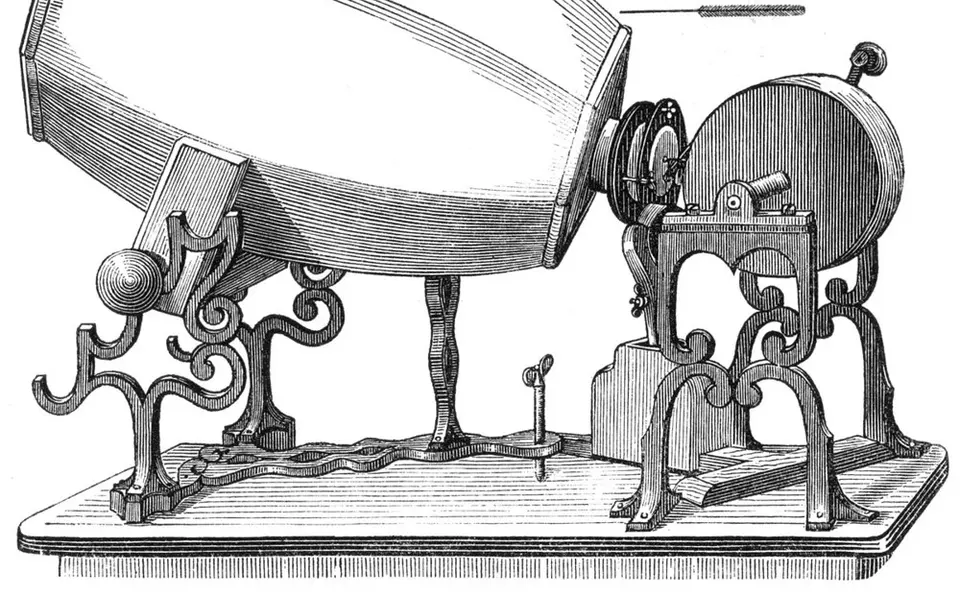
In 1860 someone in Paris sang a French folk song into a horn, and a bristle scratched it into sooty paper as a wavy line.
On April 9, 1860, someone in Paris sang part of the French folk song "Au clair de la lune" into a large horn. At its narrow end a thin membrane shook with the sound and moved a stiff bristle. The bristle traced a wavy line through a coat of soot on paper wrapped around a turning cylinder. For 148 years, nobody heard it.
The machine was the phonautograph, and its inventor was Édouard-Léon Scott de Martinville, a Paris printer. In the early 1850s, while proofreading illustrations for a textbook, he came across drawings of the human ear. He set out to copy the ear in a machine: a membrane for the eardrum, and a set of levers for the small bones behind it. He patented the phonautograph in France on March 25, 1857.
Scott never meant to play anything back. He had written a history of shorthand, and he wanted a machine that could take down every word of a conversation. People, he thought, would learn to read the wavy lines the way they read text. Nobody managed to. Scientists did use the machine to study vowel sounds and to measure pitch, by recording a reference tone of known pitch alongside the sound.
Before the 1870s, nobody thought the lines held enough information to rebuild the sound. In 1877 Thomas Edison's phonograph pressed sound into a sheet of tinfoil and played it straight back. Edison was probably unaware of Scott's work. In 1878 Scott published a short book arguing that the French invention had come first. He never made money from the phonautograph and spent the rest of his life as a Paris bookseller, dealing in prints and photographs. He died in 1879.
Coca-Cola was first sold where?
WhyJacobs' Pharmacy in Atlanta sold it at the soda fountain in 1886, 5 cents a glass.
His recordings stayed among his papers at the French patent office and the Academy of Sciences. In 2008 a group of American audio historians called First Sounds tracked them down and obtained high-resolution scans. Scientists at Lawrence Berkeley National Laboratory in California used software to turn the scanned lines into sound. Until then, the oldest known recording of a human voice was thought to be one made on Edison's phonograph in 1877.
In March 2008 First Sounds released the 1860 song. It ran about 10 seconds and sounded like a woman or a child singing at a normal pace. The team had misread the reference tone on the sheet, and the recording was playing at double speed. At the right speed it lasts 20 seconds, and the voice is a man's, singing very slowly. Notes Scott wrote with other recordings suggest the singer was most likely Scott himself.
Before 2008, the oldest known recording of singing was an Edison wax cylinder of a choir performing Handel, made in 1888. Scott's song is 28 years older.