 TouchéGet the app
He bet $50 he could drive across America, and he had no car
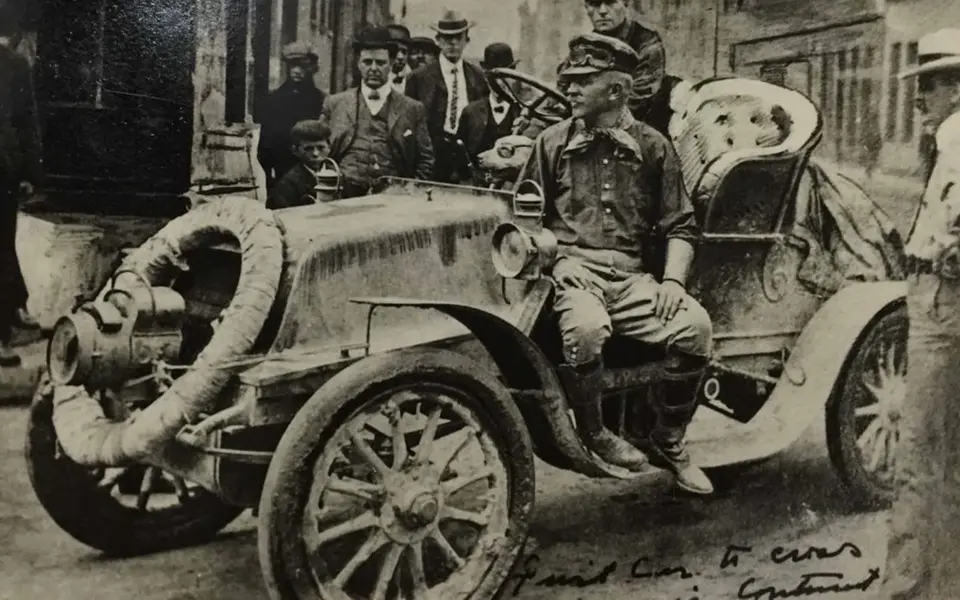
In May 1903, at a San Francisco club, a Vermont doctor named Horatio Nelson Jackson took a $50 bet that a car could cross America in under 90 days.
On May 18, 1903, at the University Club in San Francisco, a 31-year-old doctor from Burlington, Vermont, agreed to a $50 bet. The bet was that a car could be driven across the United States in less than 90 days. At the time, many people thought the automobile was a passing fad.
The doctor, Horatio Nelson Jackson, did not own a car. He had almost no driving experience and no maps. His wife went home to Vermont by train. He hired a young mechanic and bicycle racer, Sewall Crocker, bought a slightly used two-cylinder Winton, and named it the Vermont. On May 23 they left San Francisco.
The trouble started 15 miles out, with a blown tire. Their one spare was the only tire of the right size they had been able to find in all of San Francisco. North of Sacramento, a woman sent them 108 miles out of their way so that her family could see an automobile. They hauled the car across deep streams with a block and tackle, and when tires blew out they wound rope around the wheels. In Oregon they ran out of fuel, and Crocker rode a rented bicycle 25 miles to the town of Burns to buy more.
Near Caldwell, Idaho, they picked up a passenger. Jackson had wanted a dog since Sacramento, and in a letter to his wife he said a man sold him a young bulldog for $15. Newspapers told other versions. The dog was named Bud. The Vermont had no roof and no windshield, and the dust of the alkali flats hurt Bud's eyes, so Jackson bought him a pair of driving goggles.
What does the name LEGO mean?
WhyIt's from the Danish leg godt, "play well."
From then on the three of them were celebrities, and reporters met them at every stop. In Idaho, Jackson's coat fell off the car with most of their money in it. In Wyoming they got lost and went 36 hours without food. Jackson later said that the two men had been "stealing speculative glances at Bud as we tightened our belts." A sheepherder fed them roast lamb and boiled corn. When the wheel bearings gave out, Crocker talked a farmer into handing over the bearings from his mowing machine.
After Omaha there were a few paved roads. They reached New York City on July 26, 1903, 63 days, 12 hours and 30 minutes after leaving San Francisco. The trip had cost Jackson about $8,000, and the two men never collected the $50.
Jackson then drove home to Vermont. About 15 miles from home the car broke down again. His two brothers came out in their own cars to help, both of their cars broke down, and Jackson towed them home with the Vermont. At the door of his garage, its drive chain snapped. It was one of the few original parts that had never been replaced.
In 1944 Jackson gave the Vermont to the Smithsonian Institution in Washington, D.C. Bud's goggles went with it.