 TouchéGet the app
The telegraph that caught a killer in 1845 had no letter Q
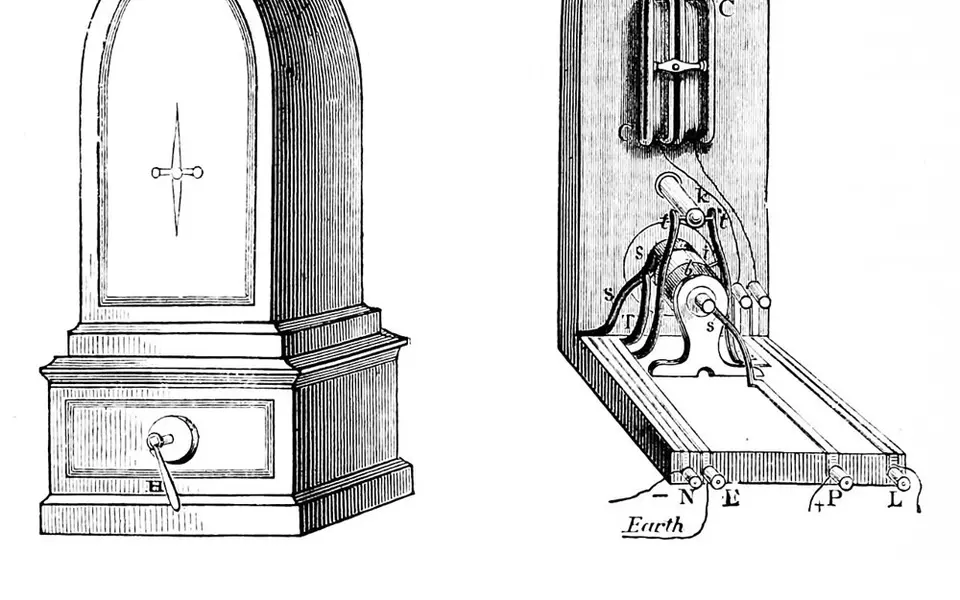
On January 1, 1845, a man in Quaker clothes left a cottage near Slough, England, shortly before the woman there died of poison. He caught a train to London.
On the evening of January 1, 1845, Sarah Hart was found poisoned in her cottage at Salt Hill, a mile outside Slough. A man in the dark clothes of a Quaker had been seen leaving the house shortly before she died. The police learned that a man of that description had boarded a train at Slough, bound for Paddington station in London.
Since 1843 an electric telegraph had run beside the railway between Paddington and Slough. The police used it to send the man's description to London ahead of the train.
The telegraph could not spell everything. Its code had no signals for some letters, among them J and Q. So the message announced that a murder had "GUST" been committed, and said the suspect was "in the garb of a kwaker." At Paddington the clerk received K, W, A, decided it was a mistake, and asked for the word again. Only after several repeats did he understand it.
The man on the train was John Tawell. In 1814 he had been transported to Australia for possessing forged banknotes. In Sydney he opened the colony's first pharmacy, grew rich, and helped set up the first Quaker community in Australia. Back in England, he was secretly keeping Sarah Hart, who had once nursed his first wife, and their two children in the cottage at Salt Hill.
What was the tiny jeans pocket first made for?
WhyLevi's still calls it the watch pocket. Cowboys and miners kept watches there.
At Paddington a sergeant of the railway police, William Williams, put on a long civilian overcoat and followed Tawell from the platform. Tawell got on an omnibus, took Williams for the conductor, and handed him sixpence for the fare. Williams stayed with him to a coffee tavern and then a lodging house, and Tawell was arrested in a coffee house.
He was tried at Aylesbury and hanged there in public on March 28, 1845. The newspaper coverage gave the electric telegraph a great deal of publicity. Until then it had been used mostly for railway signaling. After the Tawell case it came into much wider use.
The transmitter and receiver that carried the message are kept at the Science Museum in London.