 TouchéGet the app
The HMV dog was first painted listening to the wrong machine
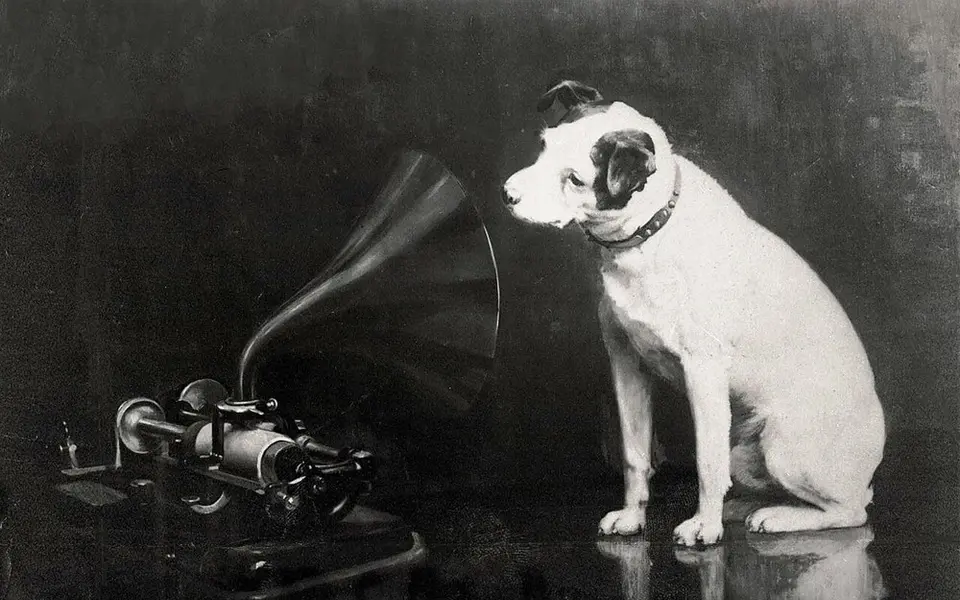
Francis Barraud painted his late brother's dog, Nipper, staring into the horn of a cylinder phonograph.
Nipper was a small mixed-breed dog from Bristol, born in 1884 and named for his habit of nipping visitors on the backs of their legs. His owner, Mark Barraud, painted stage scenery for a Bristol theater. When Mark died in 1887, his brother Francis, also a painter, took over the dog's care.
Nipper died in 1895. About three years later Francis painted him from an old photograph, sitting by a phonograph and peering into its horn. Barraud said he had often noticed how puzzled the dog was "to make out where the voice came from" when the phonograph played. He called the picture His Master's Voice.
Nobody wanted it. Publishers showed little interest, and one objected that no one would know what the dog was doing. The Royal Academy, which had shown Barraud's work before, turned it down. He offered it to Edison Bell, the company whose cylinder phonograph was in the picture. Its man in London, James Hough, replied: "Dogs don't listen to phonographs."
Then someone suggested that a brass horn would look better than the black one. In May 1899 Barraud went to the London office of the Gramophone Company, which sold Emile Berliner's disc gramophones with brass horns, to ask about borrowing one. He brought a photograph of the painting. The company's head, William Barry Owen, made an offer. He would buy the picture if Barraud painted out the cylinder machine and put in one of the company's gramophones.
The rule of thirds splits a frame into how many equal parts?
WhyThe rule of thirds is older than photography. John Thomas Smith named it in his 1797 book Remarks on Rural Scenery, building on Joshua Reynolds's remarks about balancing light and dark in a painting.
Barraud did it. He was paid £100, half for the painting and half for the copyright. The image went into the company's catalog in December 1899 and onto its record labels in 1909. In 1900 Berliner registered it as a trademark in the United States, and it became the emblem of the Victor Talking Machine Company, later RCA Victor.
Barraud never had another success like it. By 1913 he was struggling for money, and he spent much of the rest of his career painting copies of His Master's Voice, many of them for executives of the Victor company. In 1919 Victor and the Gramophone Company arranged a pension for him of £250 a year.
Nipper had been buried in Kingston upon Thames, in a small park with magnolia trees. The site was later built over, and a branch of Lloyds Bank stands on it. In 1984 the chairman of the HMV record stores put up a plaque at the back of the bank, near where the dog is thought to lie. In 2010 a small road nearby was named Nipper Alley.