 TouchéGet the app
In 5,000 snowflake photos, a Vermonter found no two alike
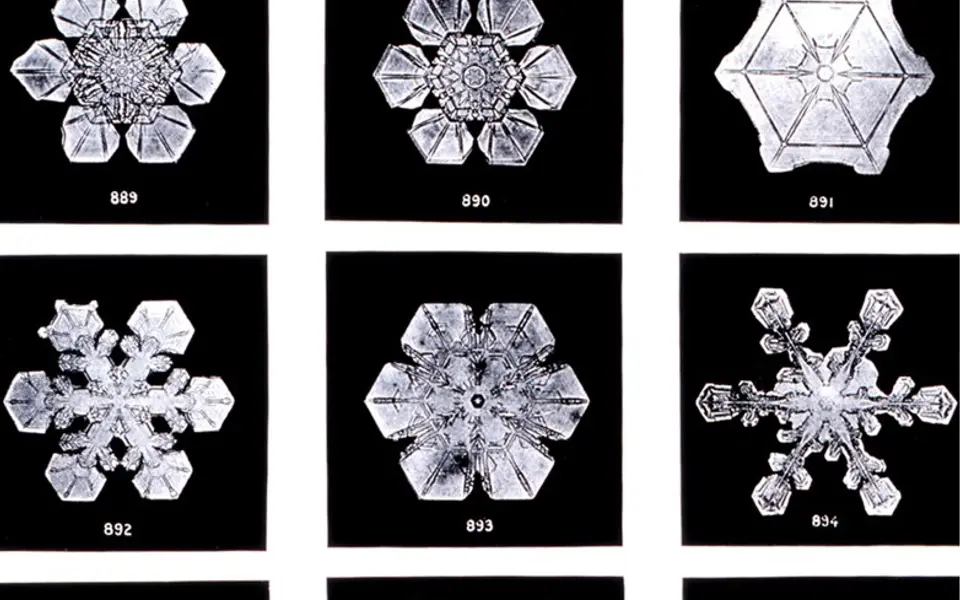
Wilson Bentley got an old microscope from his mother at 15, on a farm in Jericho, Vermont. In 1885 he fixed a camera to it and photographed his first snowflake.
Wilson Bentley grew up on his family's farm in Jericho, Vermont, and as a teenager he fixed on snow crystals. Farm people there dreaded winter, he said later, "but I was supremely happy." When he was 15 his mother gave him an old microscope. He tried to draw the flakes he saw through it, but they were too intricate to finish before they melted.
So he attached a bellows camera to a compound microscope. After a great deal of trial and error, he photographed his first snowflake on January 15, 1885. He had to be quick. Even below freezing, a snowflake slowly disappears as its ice turns straight into vapor, so each crystal had to be caught and moved onto a microscope slide fast.
Over the following decades he made more than 5,000 photographs of snow crystals. With George Henry Perkins, a professor of natural history at the University of Vermont, he published an article arguing that no two snow crystals were alike. The idea caught the public imagination, and Bentley went on to write for National Geographic, Nature, Popular Science and Scientific American.
In 1931 he and William Humphreys of the U.S. Weather Bureau published Snow Crystals, a book illustrated with 2,500 of his photographs. It came out shortly before Bentley died, on December 23, 1931, of pneumonia. He may have caught it walking home through the snow.
What does "35 mm" measure in 35 mm film?
WhyThe width came from the movies. In Thomas Edison's lab, William Dickson cut 70 mm stock from Eastman Kodak in half lengthwise, and still cameras borrowed the result, with the Leica popularizing it in the 1920s.
Kenneth Libbrecht, a Caltech professor who studies snow crystals, has noted that Bentley's methods are essentially the ones still used today. Bentley did the job so well, Libbrecht wrote, that hardly anybody bothered to photograph snowflakes for almost 100 years.
Later photographic surveys of fresh snow showed that most snowflakes are irregular. The simple, symmetrical shapes in Bentley's pictures turned out to be rare, and studies suggest that fewer than 1 in 1,000 snowflakes has the ideal six-armed form.
His other claim is harder to test. A typical snowflake holds an estimated 10 quintillion water molecules, which build up at different rates as temperature and humidity change on the way down. Two matching flakes are very unlikely in nature. Nearly identical ones have been grown under controlled conditions in laboratories.