 TouchéGet the app
The oldest surviving aerial photo shows Boston, not Paris
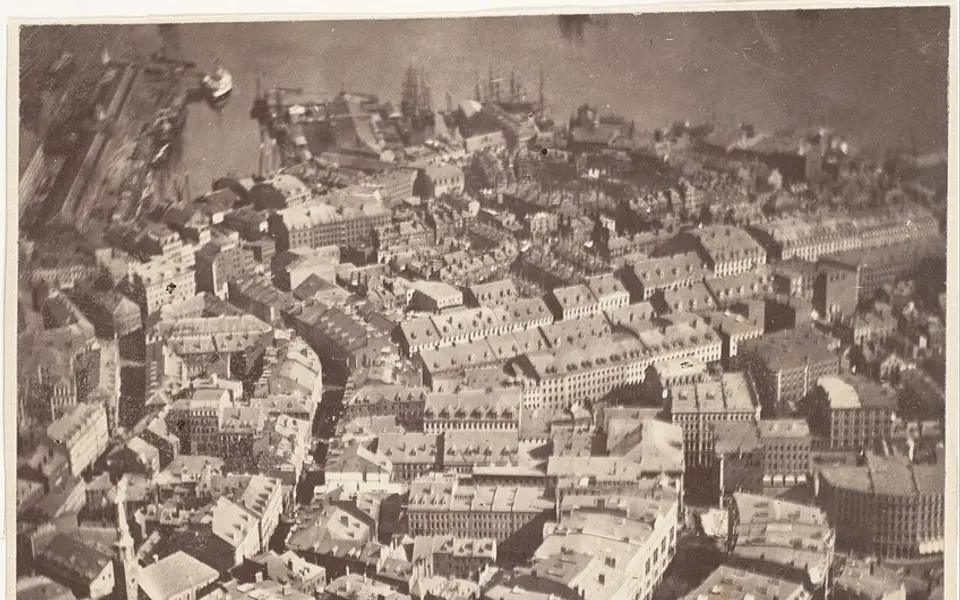
The photographer Nadar took the first aerial photographs from a balloon over Paris in 1858, once he had stopped gas from the balloon spoiling his plates. None of them survive.
Nadar was the working name of Gaspard-Félix Tournachon, a Paris caricaturist who took up portrait photography in the 1850s. Friends gave him the nickname, perhaps from his habit of tacking "dar" onto the ends of words. His studio photographed Victor Hugo, Charles Baudelaire, Sarah Bernhardt and Eugène Delacroix.
In 1858 he became the first person to take photographs from the air, from a balloon over Paris. He used the wet collodion process, so each glass plate had to be prepared and developed right there in the basket, and the process needed a chemically neutral setting. Gas escaping from the balloon above him spoiled the images. Nadar solved it by draping a gas-proof cotton cover over the basket, and after that he got stable pictures.
None of those photographs survive.
Two years later the Boston photographer James Wallace Black tried the same thing. On October 13, 1860, he went up with the balloonist Samuel Archer King in King's balloon, the Queen of the Air. Black exposed eight glass plates, each about 10 by 8 inches. One good print came out of them, and he gave it a title: Boston, as the Eagle and the Wild Goose See It. It was the first clear aerial image of a city, and it is the oldest aerial photograph that survives.
Which roof style is named for a 17th-century French architect?
WhyA popular story says Mansart invented the roof to dodge a window tax, but the French window tax came 132 years after his death. The earliest known example is by Pierre Lescot, at the Louvre around 1550.
Soon afterward both sides in the American Civil War sent up balloons to watch the enemy. There is no credible evidence that anyone managed to take useful photographs from them.
Nadar stayed in the air. In 1863 he had a balloon built that was 196 feet tall and called it Le Géant, the Giant. When he took it to Brussels in September 1864, he put up movable barriers to hold the crowd back, and Belgians still call crowd barriers Nadar barriers. During the Siege of Paris in 1870 and 1871, Nadar helped organize balloon flights that carried mail out of the surrounded city.
In April 1874 Nadar lent his photo studio to a group of painters for their first exhibition. They became known as the Impressionists.