 TouchéGet the app
The Night Watch was cut down to fit a wall in 1715
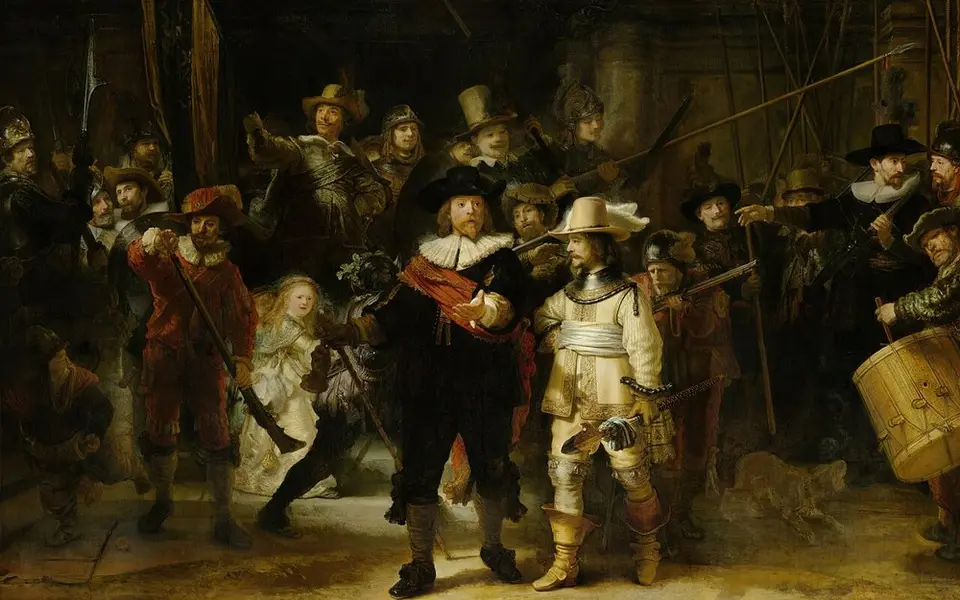
Rembrandt's militia portrait went into Amsterdam's Town Hall, and the canvas was trimmed there, most likely to fit between two columns.
Rembrandt finished the painting in 1642 for the great hall of the Kloveniersdoelen, the musketeers' meeting hall in Amsterdam. The company's captain, Frans Banninck Cocq, and 17 of his men had ordered it. Rembrandt was paid 1,600 guilders, a large sum at the time.
It hung in that hall for more than 70 years. In 1715 it was moved to the Amsterdam Town Hall, and there it was trimmed. The likeliest reason is that it had to fit between two columns. Cutting a painting down to fit a wall was common practice before the 19th century.
The strips that came off took figures on the left side with them, along with the top of the arch behind the company, a balustrade and the edge of a step. None of the pieces has been found. Taco Dibbits, director of the Rijksmuseum, has said he still has some hope for the left-hand strip, since Rembrandt's paintings were already expensive by 1715.
The lost parts are known from a copy. A few years after Rembrandt finished, the Amsterdam painter Gerrit Lundens made a much smaller version of the whole scene. It shows the painting as it was before 1715, and it belongs to the National Gallery in London.
Which New York skyscraper did King Kong climb in the 1933 film?
WhyThe Empire State Building went up in 410 days, at about four and a half stories a week. Its spire was designed as a mooring mast for airships, but high winds made docking impractical and the plan was dropped.
The cut changed the composition as well as the size. Rembrandt had placed the captain and his lieutenant off-center, with the company marching toward an empty space on the left. Since 1715 the two officers have stood in the middle of the picture. Alexander Korda's 1936 film Rembrandt gets this wrong: it shows the newly finished painting already in its trimmed shape.
In 2021 the Rijksmuseum put the missing strips back for three months. Researchers used neural networks to rebuild them from Lundens's copy, in Rembrandt's colors and brushwork. They also corrected for the angle of the copy, since Lundens must have been sitting to the left of the painting when he made it. From June to September the rebuilt strips hung attached to the real canvas.
Then they came down. The museum did not want to "trick" visitors into thinking they were seeing the full original, so the additions were never meant to stay.