 TouchéGet the app
The fortune cookie most likely came to America from Japan
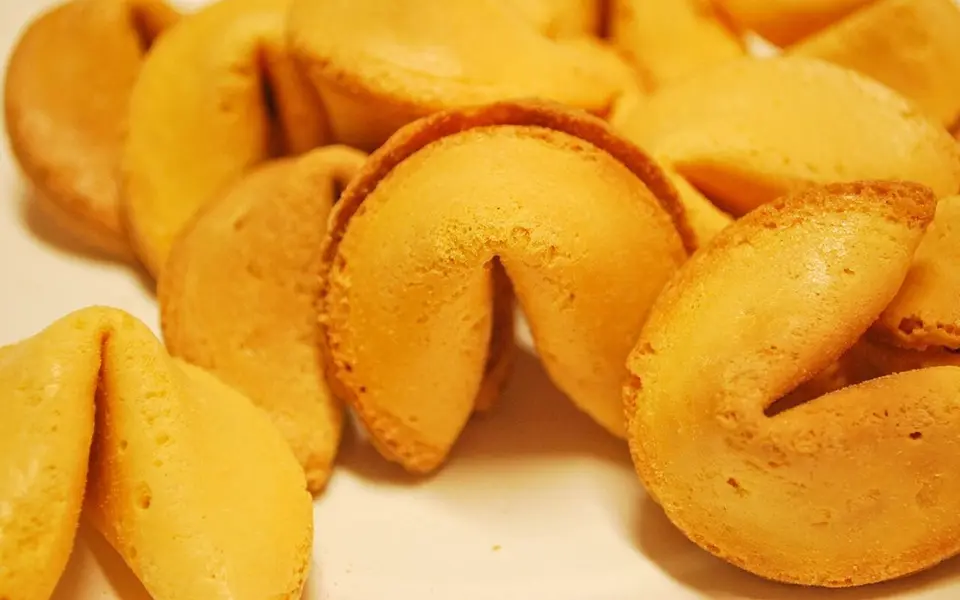
Bakers in Kyoto were making a small cookie with a paper fortune tucked into its fold by the 19th century.
In 1983 San Francisco's Court of Historical Review took up the question of who invented the fortune cookie. One claim came from Los Angeles, where David Jung, the founder of the Hong Kong Noodle Company, said he had made the first one in 1918. During the hearing a fortune cookie was entered as evidence. Its message read, "S.F. Judge who rules for L.A. Not Very Smart Cookie." The judge, a San Franciscan, ruled for San Francisco's candidate, Makoto Hagiwara. Los Angeles condemned the decision.
Hagiwara had come to the United States from Japan in 1878. From 1895 he looked after the Japanese Tea Garden in Golden Gate Park. He is reported to have served fortune cookies there in the early 1900s, made for him by a San Francisco bakery called Benkyodo. A third claimant, Seiichi Kito, founded Fugetsu-do in the Little Tokyo district of Los Angeles. He said the idea came from omikuji, the paper fortunes sold at temples and shrines in Japan, and that he sold his cookies to Chinese restaurants.
Two of the three claimants were Japanese. So, most likely, was the cookie. Bakers in Kyoto were making one very like it in the 19th century, called tsujiura senbei. It is a little bigger and darker than the American kind, and the batter has sesame and miso in it. The fortune is wedged into the bend of the cookie instead of sitting in the hollow. It is still sold near the Fushimi Inari shrine in Kyoto.
In America the Japanese version was eaten with tea, and until around World War II the cookies were known as fortune tea cakes.
What do you call an egg cooked in water without its shell?
WhyA whirlpool helps. Stir the water into a spin before the egg goes in, and the white can wrap around the yolk.
Around the war, the business passed to Chinese-Americans. One explanation is internment. In 1942 more than 100,000 Japanese-Americans were sent to camps, among them the people who made fortune cookies, and Chinese manufacturers took their place.
The Hagiwaras were sent away too. Makoto had died in 1925, and his daughter Takano and her family were running the tea garden. They were evicted from their home in the garden and sent to an internment camp. While they were gone, the garden was renamed the Oriental Tea Garden, and its Japanese tea servers were replaced with Chinese women in traditional dress.
The cookies were traditionally shaped by hand. Bakers put the fortune on a warm circle of baked dough and folded it with chopsticks before it hardened. In the late 1960s Edward Louie invented a machine that did the job, and mass production made the cookies cheap enough to hand out free after a meal.
In 1992 Wonton Food, a fortune cookie maker in Brooklyn, tried to sell them in China. It gave up. The cookies were considered too American.