 TouchéGet the app
Helium turned up in sunlight 27 years before it did on Earth
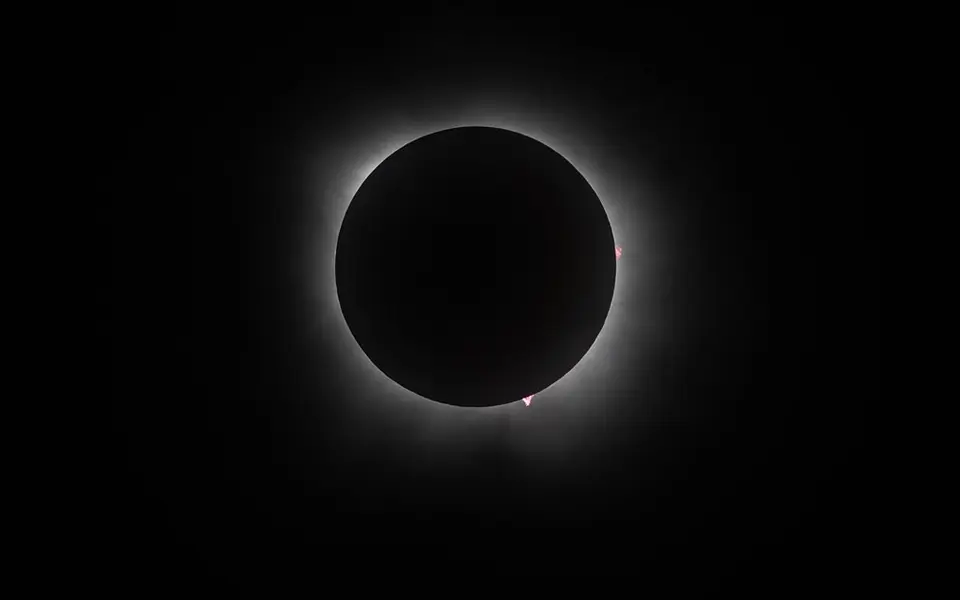
During a total eclipse in 1868, astronomers saw a yellow line in the light from the edge of the Sun that matched nothing known on Earth.
On August 18, 1868, a total eclipse of the Sun crossed India. Astronomers there pointed spectroscopes at the edge of the darkened Sun, at a glowing layer of its atmosphere called the chromosphere. One of them, the French astronomer Jules Janssen, was at Guntur. Among the bright lines in that light was a yellow one. At first it was taken for sodium.
A spectroscope spreads light out into its colors. A hot gas gives off light only at particular colors, which show up as bright lines, and every element has its own set. So a set of lines can tell which elements a glowing gas contains. Sodium gives two yellow lines close together, known as D1 and D2. The new line sat near them, but not in the same place.
Janssen noticed how bright the lines were and realized he could study them without waiting for an eclipse. In England, Norman Lockyer set up a new spectroscope, and on October 20 he saw the same yellow line from London. He called it D3. He ruled out a new form of hydrogen and concluded that the line came from an element in the Sun that was unknown on Earth. He named it helium, from helios, the Greek word for the Sun.
Janssen's report and Lockyer's reached the French Academy of Sciences on the same day, and the two usually share the credit. Names ending in -ium normally belong to metals, such as sodium and calcium. Lockyer was an astronomer and probably did not know the chemists' convention.
Which part of the brain controls balance and coordination?
WhyThe cerebellum sits at the back of the skull and fine-tunes every movement the body makes. Damage to it can leave someone able to move but unable to move smoothly. Its name comes from Latin for "little brain."
The line did not show up on Earth for 13 years. In 1881 the Italian physicist Luigi Palmieri saw it in material from a recent eruption of Mount Vesuvius.
On March 26, 1895, the Scottish chemist William Ramsay was looking for argon. He treated a uranium mineral called cleveite with acid and collected the gas that came off. After removing the nitrogen and oxygen, he saw a bright yellow line matching D3. Ramsay had planned to call his new gas krypton. Lockyer and the physicist William Crookes identified it as helium. In Sweden that same year, Per Teodor Cleve and Abraham Langlet got helium from cleveite on their own. Earlier, the American William Hillebrand had seen strange lines while testing a uranium mineral, and put them down to nitrogen.
The uranium explains where the helium came from. Uranium and thorium are radioactive, and as they decay they throw out particles that are the cores of helium atoms. In 1907 Ernest Rutherford and Thomas Royds showed that these particles were helium. Most of the helium on Earth was made this way, and it collects underground in pockets of natural gas.
In the air there is very little, about five parts per million. Helium released into the atmosphere escapes into space.