 TouchéGet the app
The first platypus sent to Britain was taken for a fake
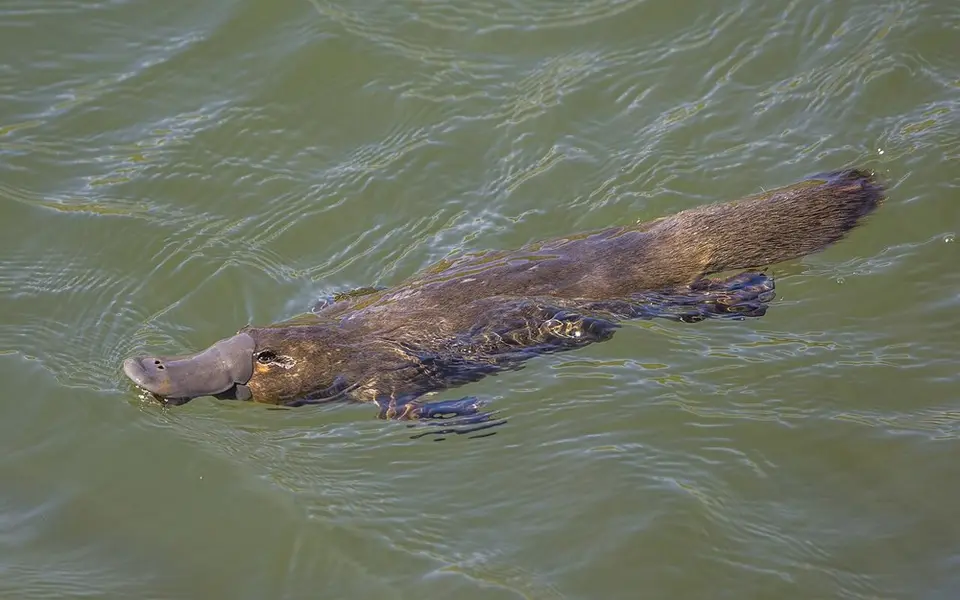
In 1799 the first scientists to examine a platypus skin suspected that someone had sewn a duck's bill onto a beaver-like body. The animal was real.
In 1798 Captain John Hunter, governor of the British colony of New South Wales, sent a pelt and a sketch of a strange animal back to Britain. It had a bill like a duck's and a tail like a beaver's, on a body covered in fur.
The scientists who saw it suspected a hoax. Somebody, they thought, had sewn a duck's beak onto the body of a beaver-like animal. George Shaw, who published the first scientific description in 1799, wrote that it was impossible not to doubt that it was genuine. He took a pair of scissors to it to check for stitches.
Shaw named it Platypus anatinus, which means roughly flat-footed and duck-like. In Germany, Johann Blumenbach described it the next year without knowing Shaw had, and called it Ornithorhynchus paradoxus. The name Platypus turned out to belong already to a genus of beetles, so the scientific name became Ornithorhynchus anatinus. In English it stayed the platypus.
Once the animal was accepted as real, the question was how it bred. The English surgeon Everard Home, who did some of the earliest studies of its anatomy, concluded that it was not an ordinary live-bearer. He suggested that its eggs hatched inside the mother. Early European naturalists did not believe that the female laid eggs.
What is a baby kangaroo called?
WhyA newborn joey is about the size of a lima bean and has to climb into its mother's pouch by itself. It stays inside for months, drinking milk. Baby koalas, wallabies and wombats are called joeys too.
In 1884 a Cambridge zoologist, William Caldwell, went to Australia to find out. He had a studentship of £200, a grant of £500 and the backing of the Royal Society. He set up camp on the Burnett River in Queensland and, with a team of 150 Aboriginal helpers, searched until he found a few eggs.
Each word of a telegram cost money, so Caldwell kept his short. He wired the British Association for the Advancement of Science, which was meeting in Montreal: "Monotremes oviparous, ovum meroblastic." The monotremes, the platypus and the echidnas, lay eggs. The eggs develop the way a reptile's do, with only part of the egg dividing.
They are the only living mammals that lay eggs. A female platypus lays two small, leathery eggs, each about two-thirds of an inch long, in a burrow that can be 98 feet long. She has no teats. When the young hatch, her milk comes out through pores in her skin, and they lap it up from her fur.
The platypus and echidna specimens Caldwell collected went to the Cambridge University Museum of Zoology. They were stored there but never catalogued, and they were found again in 2022.