 TouchéGet the app
Freud dissected hundreds of eels and never found the testes
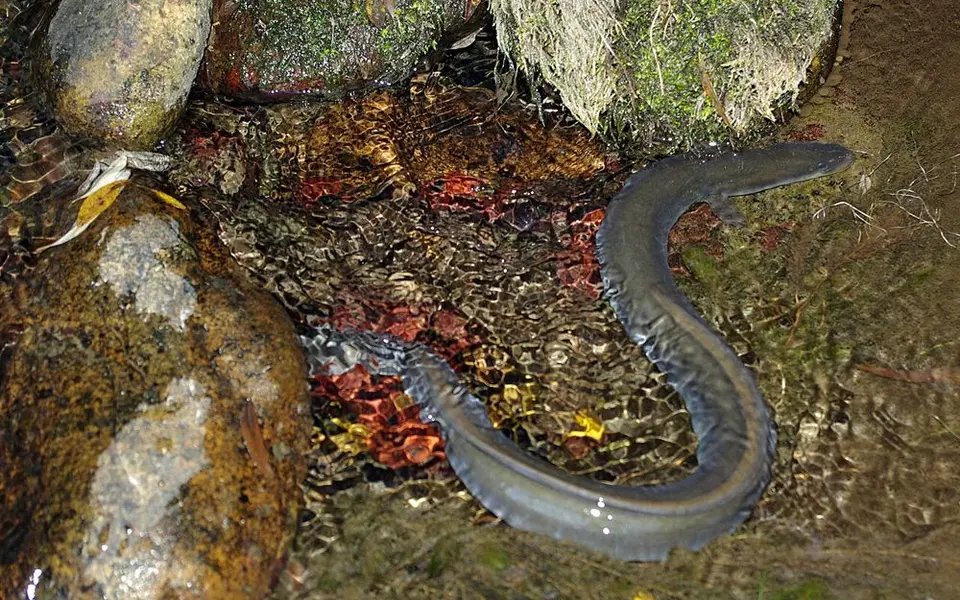
Before Freud, Aristotle had decided that eels came from earthworms formed in mud, and fishermen never caught anything they recognized as a young eel.
Aristotle wrote that eels had no sex organs and no spawn, and that they came from earthworms, which formed out of the mud. Many centuries passed before anyone could show otherwise, because fishermen never caught anything they recognized as a young eel.
In 1777 the Italian Carlo Mondini found an eel's ovaries. The males were harder. In 1876 Sigmund Freud, then a medical student in Vienna, was given the job of finding their sex organs. He spent four weeks at a zoological station in Trieste and dissected hundreds of eels. His first major published paper had to admit that he had failed. The male organs were first seen about twenty years later, in an eel caught off Sicily.
Part of the trouble was that young eels look nothing like eels. They start out as flat, transparent larvae about two inches long, shaped like a leaf. In 1856 these were described as a species of their own, Leptocephalus brevirostris. In 1886 the French zoologist Yves Delage kept some alive in a tank at Roscoff until they turned into eels.
That still left the question of where they came from. Eel larvae had only been found in the Mediterranean, so that was where eels were thought to spawn. In 1904 the Danish biologist Johannes Schmidt began leading expeditions to look into it. On his first one into the North Atlantic, his ship caught a larva west of the Faroe Islands, the first eel larva ever seen in the Atlantic.
Schmidt kept at it for years, with money from the Carlsberg Foundation. His method was to trawl the deep Atlantic and always move in the direction where the larvae were smallest. The farther out he went, the smaller they got. In the early 1920s he reached the Sargasso Sea, south of Bermuda, and caught the smallest eel larvae anyone had seen.
Which mammal is best known for moving slowly?
WhyA sloth is faster in the water than in the trees. It swims about 44 feet a minute, more than three times its usual pace, and by slowing its heart it can hold its breath for up to 40 minutes.
Along the way, he sent a paper on the eel to the Royal Society in London. It was turned down, with a note that the work of the Italian zoologist Giovanni Battista Grassi was enough. The paper came out in Germany in 1912. Ten years later the Royal Society published Schmidt's work on where the eel spawns.
Schmidt never saw an eel spawn, or even found an adult ready to. He worked it out from the sizes of the larvae. European eels hatch in the Sargasso Sea, and the larvae drift with the Gulf Stream across the Atlantic to the coasts of Europe.
When the adults are ready to breed, they go back, a trip of about 3,700 miles. Before they leave, their gut dissolves, so they cannot eat on the way. Their eyes grow larger and their sides turn silver.
Nobody has yet watched European eels mate in the wild. In December 2018 researchers in the Azores fitted 26 large females with satellite tags and released them. The tags showed that the rest of the journey to the Sargasso Sea took them a further year or more.