 TouchéGet the app
The first known photo of a person shows a near-empty street
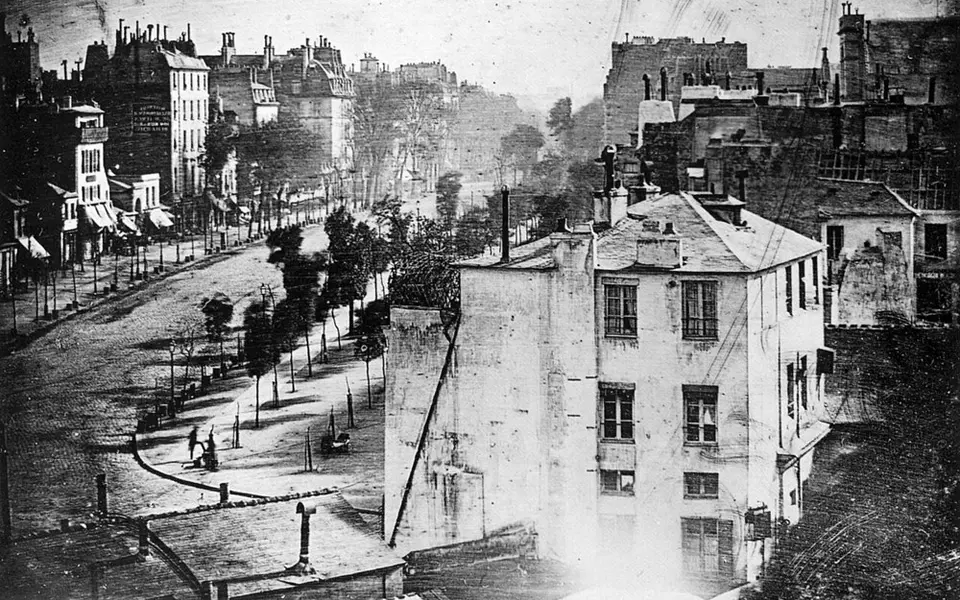
In 1838 Louis Daguerre pointed a camera out of his studio window at a busy Paris boulevard.
One spring morning in 1838, or possibly 1837, at about 8 o'clock, Louis Daguerre set up a camera at a window of his studio in Paris. Below it ran the Boulevard du Temple, close to where the Place de la République is today. Daguerre also ran the Diorama, a theater that showed huge painted scenes, and his studio was beside it.
The oldest surviving camera photograph had been made about ten years earlier by his late partner, Nicéphore Niépce. It needed an exposure of about eight hours, so only things that stayed put could be recorded. Daguerre's own process cut the time to four or five minutes.
That was fast enough for buildings and slow for a street. The boulevard would have been busy with people and horse traffic. Anything that kept moving during those minutes left no mark on the plate, and the street came out looking deserted.
At a street corner in the lower left, two figures did show up: a man having his boots polished and the bootblack polishing them. They held still long enough to be recorded. It is the earliest known photograph of a person, and nobody in it was posing. Daguerre was photographing the street. Some people have suggested that the bootblack is a water pump. There may also be faint traces of other people, a horse and a child at a window.
Which ancient Greek is called the Father of Medicine?
Why"First, do no harm" is not in the Hippocratic Oath. The original swears by the healing gods and asks the new doctor to avoid harm and wrongdoing. Scholars think Hippocrates did not write the oath at all.
Daguerre announced his invention in January 1839. That March the American painter Samuel Morse visited his studio and saw this picture. The same month the studio caught fire. Daguerre told the firefighters to let the studio burn and save the house next door, which held his laboratory. His camera and his pictures were carried out. About 25 daguerreotypes that are certainly his survive today.
In October 1839 Daguerre sent King Ludwig I of Bavaria three framed pictures as a publicity gesture. This one was on the right, labeled "eight o'clock in the morning." When they went on show in Munich, a Leipzig magazine wrote that "there appeared to be a man having his boots polished who must have been standing extremely still."
The plates stayed in Bavaria and slowly deteriorated. In 1936 or 1937 the American photography historian Beaumont Newhall found them and made copies. During World War II the originals were stored in poor conditions. In 1970 they were lent to the Munich City Museum, and an attempt to restore them ended in disaster, ruining them further. The picture in circulation today comes from Newhall's copies.