 TouchéGet the app
His sea watch passed the test, and the judges called it luck
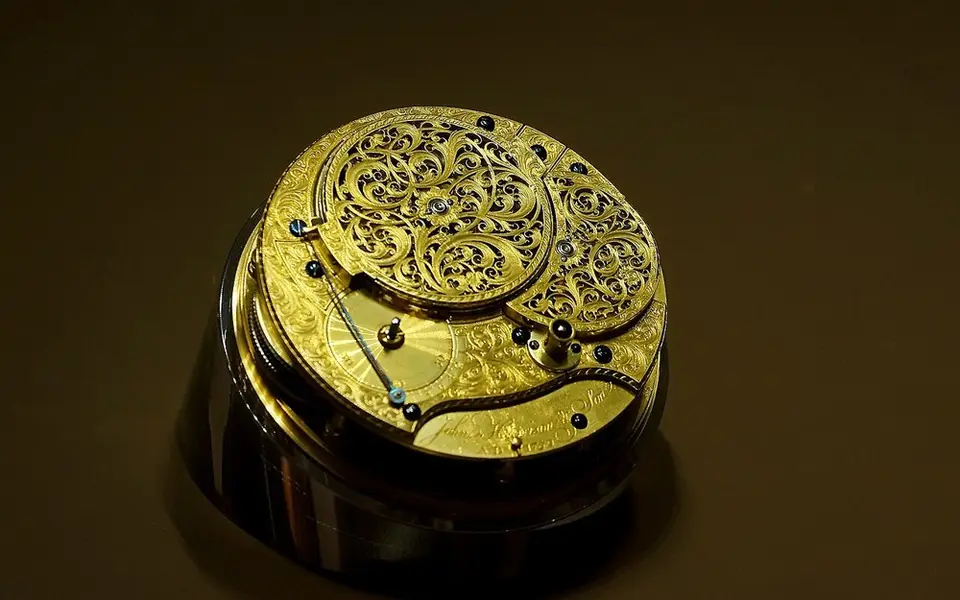
In 1714 Britain offered £20,000 for a way to find a ship's longitude at sea.
In 1714 the British Parliament offered £20,000 to anyone who could find a ship's longitude at sea to within half a degree, on a voyage from Britain to the West Indies. A panel, the Board of Longitude, would judge the entries.
Longitude is a matter of time. Each hour of difference between local time and the time at a fixed reference place, such as Greenwich, means 15 degrees of longitude. A navigator could find local noon from the sun. What he needed was the time back home, and that meant a clock that kept good time for weeks on a rolling ship, through heat, cold, damp and salt air. Isaac Newton doubted it could be done: "when longitude at sea is lost, it cannot be found again by any watch."
John Harrison was a joiner from Lincolnshire who built clocks in his spare time, the first ones with works made entirely of wood. In 1730 he went to London with a design for a sea clock. Edmond Halley, the Astronomer Royal, sent him to George Graham, the country's leading clockmaker, who lent him money to build it.
The first sea clock took five years. In 1736 it went to Lisbon and back. On the way home the ship's master worked out that they were 60 miles east of where they turned out to be. Harrison, using the clock, had it right. The Board gave him money to keep going, and he spent the next 25 years on two more sea clocks and then a watch about five inches across.
In November 1761 the watch, now known as H4, sailed for Jamaica aboard HMS Deptford, in the care of Harrison's son William. Harrison was 68. After 81 days, allowing for the small amount it was known to lose each day, the watch was 5 seconds slow. That put the ship's longitude off by about one nautical mile.
Who created the first vaccine, using cowpox to fight smallpox?
WhyJenner noticed that milkmaids who caught cowpox rarely got the deadly smallpox. In 1796 he tested his idea on a young boy, and it worked. The word "vaccine" comes from the Latin word for cow.
The Board did not pay. Its members thought the result could have been luck, and doubted that a watch that had taken six years to build was practical. They ordered another trial.
The second voyage went to Barbados. The astronomer Nevil Maskelyne was sent to test the rival method, which worked out longitude from the angle between the Moon and the Sun. The watch fixed the longitude of Bridgetown to within 10 miles. Maskelyne's figure was within 30 and needed a lot of calculation. The Board again put the watch's accuracy down to luck.
Harrison was offered half the prize once he revealed how the watch worked, and the rest once he showed it could be copied. Meanwhile Maskelyne had become Astronomer Royal and a member of the Board. He tested H4 and reported against it. The Harrisons later accused him of bias.
In his late seventies, Harrison went to King George III. For ten weeks in 1772 the king tested Harrison's next watch at the palace himself and found it accurate to within a third of a second a day. He told Harrison to petition Parliament, and threatened to go there and give its members a dressing-down in person.
In 1773, at 80, Harrison was granted £8,750 by Parliament. Over 36 years he received £23,065 in all. He died three years later. The £20,000 prize itself was never awarded to anyone.