 TouchéGet the app
The first Atlantic cable's chief electrician burned it out
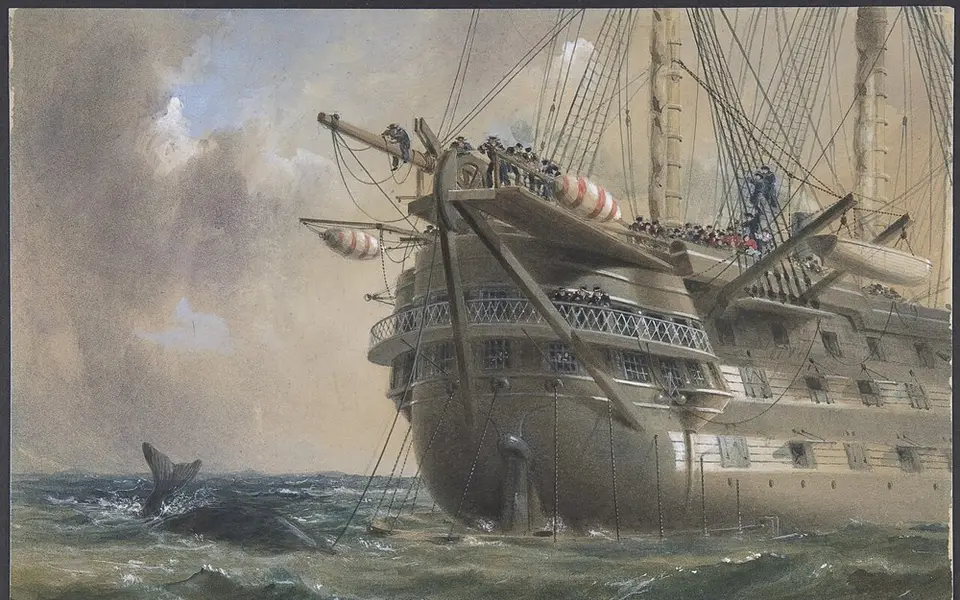
In August 1858 a telegraph cable finally joined Ireland to Newfoundland, and New York fired a 100-gun salute. Signals crawled through it at about two minutes a letter.
The cable was a core of copper strands wrapped in gutta-percha, a natural rubber, and armored with wire. On July 29, 1858, two warships, Britain's Agamemnon and the American Niagara, spliced their halves together in the middle of the Atlantic and steamed apart, paying it out. By August 5 one end was ashore on Valentia Island in Ireland and the other in Trinity Bay, Newfoundland.
The project's chief electrician was Wildman Whitehouse, a surgeon who had given up his practice for electrical experiments. He had no formal training in physics. The project's scientific adviser was William Thomson, the physicist later known as Lord Kelvin. They had disagreed for years.
Thomson had worked out that a cable this long, a copper core inside insulation lying in seawater, would hold back and smear each pulse, so signals would crawl. The effect was called retardation, and Thomson wanted a thicker cable to reduce it. Whitehouse joined underground land lines end to end to the same length, tested them overnight and declared there would be no problem. Cyrus Field, who drove the project, went with the thinner, cheaper cable.
They also disagreed about how to listen. Thomson had built a mirror galvanometer, a very sensitive detector that could pick up weak pulses sent with ordinary low voltages. Its signals had to be read by eye. Whitehouse wanted big induction coils producing several thousand volts, enough current to work the printing telegraphs used on land.
Whitehouse kept finding reasons not to sail, so Thomson went on Agamemnon alone. Using his galvanometer, he got clear signals the whole way to Ireland. At Valentia he handed over, and Whitehouse connected his own equipment.
How many bones are in an adult human skeleton?
WhyBabies are born with around 300 separate bones, and many fuse together as they grow. By adulthood that settles at 206. Roughly half of them are packed into the hands and feet alone.
Test messages went across from August 10. On August 16 Queen Victoria's message to President James Buchanan went through, 98 words that took 67 minutes to reach Newfoundland. Each letter took about two minutes. New York answered with a 100-gun salute, flags and church bells, and on September 1 a parade and a fireworks display that set the town hall on fire.
Whitehouse could not read the copy of the queen's message sent back to Ireland. It arrived in the end on Thomson's galvanometer, after Whitehouse gave up on his own instruments. He then had it entered into his printing telegraph, so that he could send on the printed tape as if it had been received that way.
Meanwhile his repeated high-voltage pulses were damaging the insulation. The cable was badly made in places, with the copper sitting off-center in its covering. Later tests showed what high voltage did to a sample with a hole the size of a pinprick: it "lit up like a lantern" and burned a large hole in the insulation.
In September 1858, after several days of steady decline, the cable stopped working altogether. In all, 732 messages had passed through it. Whitehouse was dismissed, and an inquiry in 1861 put most of the blame on him. The cable might have failed in any case, but he brought the end much sooner.
The cable laid in 1866 carried 8 words a minute, 80 times faster than the one of 1858. Since then Europe and America have never been without a cable connection.