 TouchéGet the app
The apple never hit Newton, and his tree is still growing
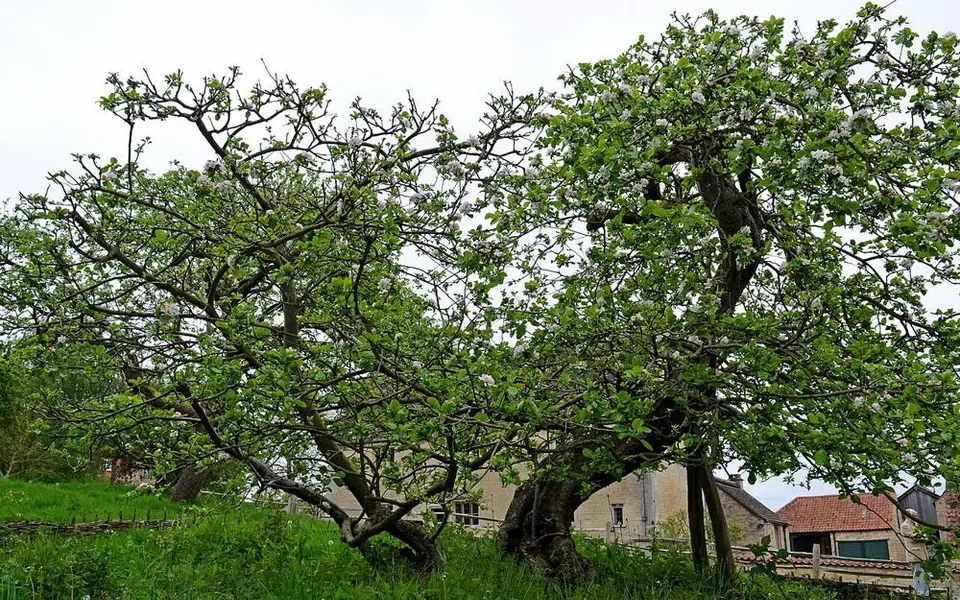
Isaac Newton told the apple story himself, late in life, over tea under some apple trees in 1726.
On April 15, 1726, the antiquarian William Stukeley went into a garden in Kensington with Isaac Newton, and the two of them drank tea in the shade of some apple trees. Newton was 83. He told Stukeley that he was in just the same situation as when the idea of gravitation had first come into his mind.
An apple had fallen while he sat thinking, Stukeley wrote, and Newton had asked himself why it should always come straight down, and never go sideways or upward. His answer was that the Earth draws it. And if matter draws matter in proportion to how much of it there is, then, in Stukeley's record of his words, "the apple draws the earth, as well as the earth draws the apple."
John Conduitt, the husband of Newton's niece, put the scene in 1666. Cambridge University had closed because of the plague, and Newton had gone home to Woolsthorpe Manor, his family's farmhouse in Lincolnshire. Conduitt also wrote down where the thought went next. The pull that brought the apple down need not stop near the ground. Why not as high as the Moon, Newton asked himself, and if it reached that far, it might be what kept the Moon in its orbit. He began to calculate.
His notebooks show him in the mid-1660s comparing the Moon's orbit, its period and its distance, with the timing of objects falling on Earth. He was testing an idea that others had also suggested: that gravity weakens with the square of the distance, so that twice as far away the pull is a quarter as strong.
What is the smallest bone in the human body?
WhyThe stapes sits deep in the middle ear and is smaller than a grain of rice. It is one of three tiny bones that pass sound vibrations to the inner ear.
He did not publish. He could not yet prove that the Earth pulls as if all its mass were packed into a point at its center. That matters for an apple, which sits on the surface with the planet's mass spread out below and around it. The proof took him twenty years. His book on gravity and motion, the Principia, came out in 1687.
The apple story reached the public through Newton's niece, Catherine Barton, who told it to Voltaire. He put it in print in 1727, the year Newton died. Stukeley's memoir of 1752 is one of the earliest written sources. People who heard the story from Newton passed it on, but none of their versions has the apple hitting his head.
Historical accounts, tree-ring dating and DNA analysis point to the one apple tree in the garden at Woolsthorpe as the tree Newton described. In the early 1800s it blew over in a storm. It grew back from its roots, and the National Trust now looks after it, behind a fence.
A descendant of the tree grows outside the main gate of Trinity College, Cambridge, below the room where Newton lived as a student. The National Fruit Collection in Kent supplies grafts of it. Its apples appear identical to Flower of Kent, a coarse-fleshed variety grown for cooking.