 TouchéGet the app
An argument over frog legs produced the first battery
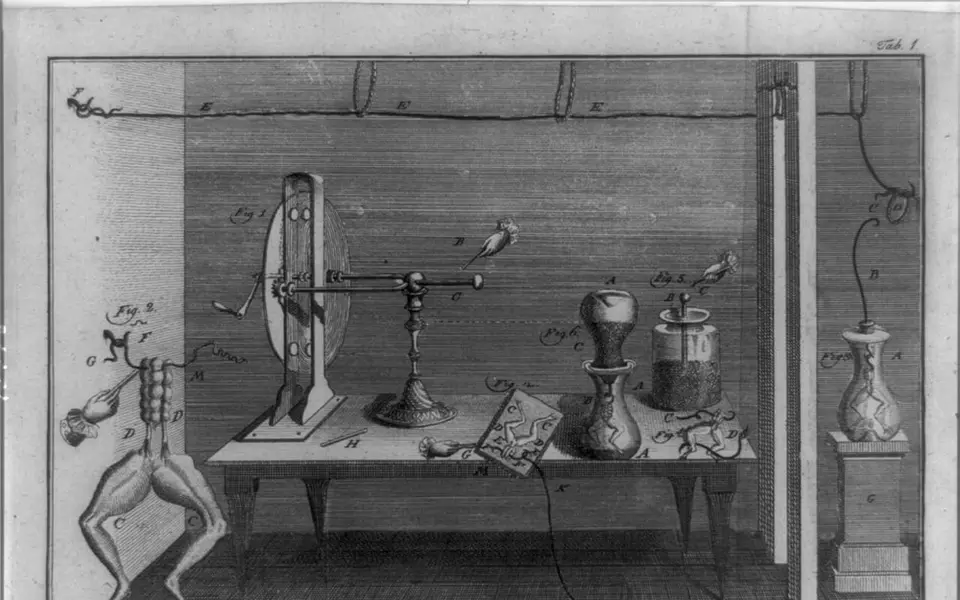
In the 1780s Luigi Galvani found that a dead frog's legs twitched when he joined them to brass and iron, and decided the electricity came from the frog.
In the 1780s Luigi Galvani, who taught anatomy in Bologna, was studying how electricity affected the muscles of dead frogs. A spark from an electrical machine made the legs twitch. So, he found, did lightning. He had hung prepared frog legs from an iron railing on brass hooks run through the spinal cord. The legs jerked when lightning struck, and they also jerked when he pressed the brass hooks against the iron.
In his laboratory he got the same result by touching brass connected to the frog's spinal cord to an iron plate. There was no machine and no lightning. Galvani concluded that the electricity came from the frog itself. He called it animal electricity, and he took it for the force that animated living things. In 1791 he published a book on more than ten years of this work, and it set off a heated argument across Europe.
Alessandro Volta, a professor of physics at Pavia, was among the first to repeat the experiments. At first he accepted animal electricity. Then he began to suspect the metals. The legs twitched when two different metals were joined through them, and he came to think the frog was not making the electricity at all.
Volta worked out that the leg was doing two jobs. Its wet tissue carried a current between the metals, and its muscle twitched when a current flowed, which showed that the current was there. The current itself came from the two different metals. He took the frog out, put paper soaked in brine between the metals instead, and detected the current with other instruments.
What is stainless steel mostly made of?
WhyStainless steel is mostly iron with at least 10 percent chromium mixed in. That chromium forms an invisible protective layer that stops rust from spreading. Without it, plain steel corrodes far more easily.
The effect had been noticed decades earlier by someone who did not know what it was. In 1752 the Swiss scientist Johann Georg Sulzer put his tongue to a piece of lead and a piece of silver joined at the edges, and tasted something like iron sulfate. Neither metal alone had any taste. He guessed that the contact made the particles in the metals vibrate.
To settle the argument, Volta built a source of electricity with no animal in it. He first tried a row of wine goblets filled with brine, each with two different metals dipped in it. Then he stacked discs of copper and zinc, with cardboard soaked in brine between them. Connected top to bottom by a wire, the stack gave a steady current. He described it in a letter to the Royal Society in London dated March 20, 1800. It was the first battery that could supply a current continuously.
Galvani did not live to see it. In 1798 the Cisalpine Republic, the French-backed government in northern Italy, required every professor to swear loyalty to it. Galvani refused and was stripped of his posts. His nephew won his reinstatement, but it was announced only shortly before Galvani died, in December 1798.
The two men had disagreed respectfully. Volta named the making of electricity by chemical action "galvanism," after Galvani, who is now called the father of electrophysiology, the study of electricity in living tissue. The unit of voltage, the volt, is named after Volta. Galvani's name survives in the verb galvanize.