 TouchéGet the app
Hubble's mirror was polished precisely to the wrong shape
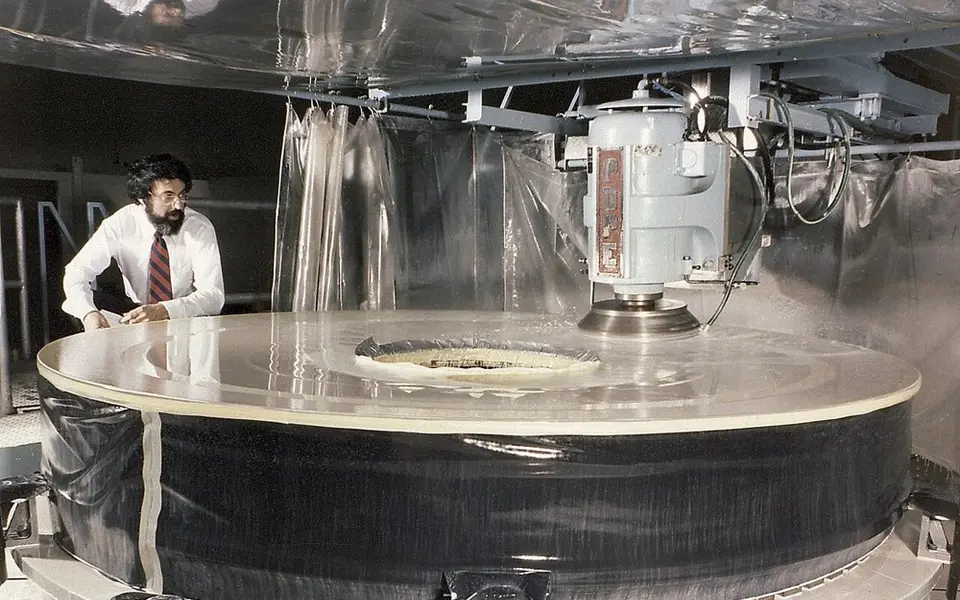
When the Hubble Space Telescope reached orbit in 1990, its pictures came back blurred.
On April 24, 1990, the space shuttle Discovery carried the Hubble Space Telescope into orbit. Within weeks its first pictures showed a problem. A star should have come out as a sharp point. Instead each one was a bright core inside a blurry halo, many times wider than the design allowed.
The fault was in the main mirror, nearly 8 feet across. Its surface was smooth to about 10 nanometers, as the design required. It had been polished to the wrong shape. Its outer edge was too flat by about 2,200 nanometers, roughly one eleven-thousandth of an inch.
A telescope mirror is curved so that light from every part of it meets at one point. On Hubble's mirror, light from the edge met at a different point from light from the center, so no focus setting could bring a star to a point. Faint, distant galaxies were lost in the blur, and nearly all the planned work on the early universe became impossible. In the 1991 comedy The Naked Gun 2½, Hubble appears in a lineup of disasters with the Titanic and the Hindenburg.
A commission led by Lew Allen, director of the Jet Propulsion Laboratory, found how it had happened. The company that polished the mirror, Perkin-Elmer, checked its shape with a testing device called a null corrector. For the final polishing it switched to a new, custom-built one. One lens inside it had been assembled 1.3 millimeters out of place. The mirror was polished to satisfy that device, so it came out very precise and the wrong shape.
What gas do red blood cells carry to the body's tissues?
WhyA red blood cell throws out its own nucleus to make more room for oxygen. What is left is a bag of hemoglobin with no DNA. It laps the body about once a minute and lasts around four months.
A few checks with older test devices during the work had shown the error. Those results were dismissed, because the new device was considered more accurate. The commission put most of the blame on Perkin-Elmer, and it faulted NASA for relying on a single instrument. Perkin-Elmer later agreed to pay $15 million to head off a government lawsuit.
Swapping the mirror in orbit was impossible, and bringing the telescope home was too expensive. The fix depended on the mistake being so exact. Two teams measured it separately, one from the blurred pictures and one from the polishing equipment, which was still in place, and they got almost the same answer. Engineers then made small mirrors with the same error built in reverse: a pair of glasses for the telescope.
In December 1993 the shuttle Endeavour brought them up. On five spacewalks, astronauts installed a new main camera with the correction built in, and a box of correcting mirrors called COSTAR. To make room for COSTAR they removed another instrument, the High Speed Photometer. On January 13, 1994, NASA showed the first sharper pictures.
The main mirror was never fixed. Later instruments were built with their own correction, and in 2009 astronauts took COSTAR out and brought it back to Earth. It is on display at the National Air and Space Museum in Washington, D.C.