 TouchéGet the app
He waited eight years for Venus, and that day it was cloudy
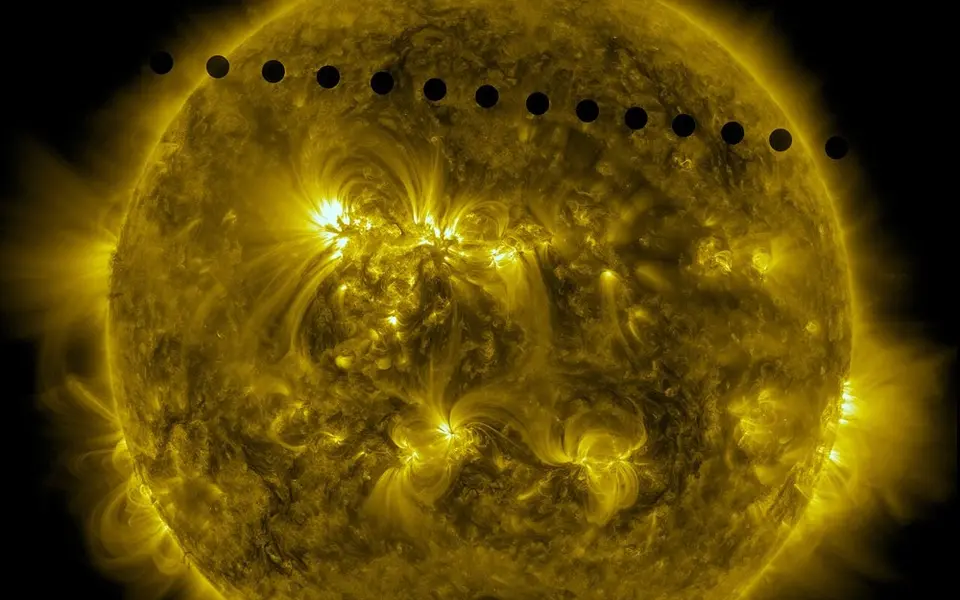
In 1761 the French astronomer Guillaume Le Gentil was at sea when Venus crossed the Sun, on a ship rolling too hard to measure anything.
On June 6, 1761, Venus passed across the face of the Sun, and the sky over the Indian Ocean was clear. Guillaume Le Gentil, a French astronomer, was out on that ocean aboard a French frigate. He had left Paris fifteen months earlier to measure this event. The ship was rolling too much for him to make any observations at all.
In 1691, and again in 1716, Edmond Halley had argued that a transit of Venus, measured from places far apart on Earth, would give the distance from the Earth to the Sun by triangulation. Transits of Venus come in pairs eight years apart, and then not again for more than a century. The next pair was due in 1761 and 1769. France and Britain sent observers to places that included Siberia and Newfoundland.
Le Gentil's post was Pondicherry, a French possession in India. He reached the island now called Mauritius in July 1760, but France and Britain were at war, and getting farther east was hard. In March 1761 he finally sailed on a frigate bound for India. Winds blew it off course, and it spent five weeks at sea. Near Pondicherry the captain learned that the British had occupied the city, and the frigate turned back. That is where Le Gentil was on June 6.
Having come that far, he decided to stay for the second transit. He spent some time mapping the east coast of Madagascar. He chose Manila, in the Philippines, as his next site, but the Spanish authorities there were hostile. By then a peace treaty had given Pondicherry back to France, so he went there instead. He arrived in March 1768 and built a small observatory.
On June 4, 1769, the sky over Pondicherry clouded over, and Le Gentil saw nothing.
What is the chemical symbol for carbon?
WhyA plain capital C stands for carbon, the backbone element of all known life. It shows up in everything from diamonds to the graphite in a pencil. Ca, Co and Cr belong to calcium, cobalt and chromium instead.
Elsewhere, James Cook's expedition observed the same transit from Tahiti. In 1771 the French astronomer Jérôme Lalande combined the measurements from 1761 and 1769 and put the distance to the Sun at about 95 million miles.
Le Gentil's trip home was delayed first by dysentery. Then his ship ran into a storm and left him on the island of Réunion, where he waited until a Spanish ship took him on. He reached Paris in October 1771, more than eleven years after he had set out.
He had been declared legally dead. His seat in the Royal Academy of Sciences had gone to someone else, his wife had remarried, and his relatives had divided up his estate. None of his letters had reached them, because of shipwrecks and attacks on ships during the war.
It took long lawsuits, and in the end the king's intervention, to get his seat in the academy back. He married again. His account of the voyage came out in two volumes, in 1779 and 1781.