 TouchéGet the app
London's police lost a fight with the BBC over police boxes
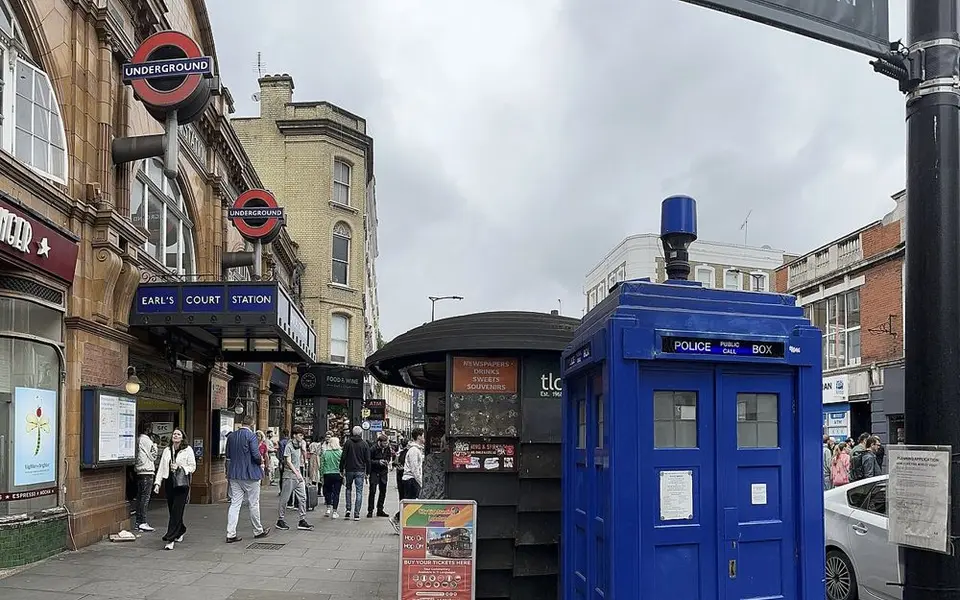
London's Metropolitan Police designed the blue police box in 1929 and put up about a thousand of them.
In 1929 Gilbert Mackenzie Trench, the surveyor and architect of London's Metropolitan Police, designed a police box. Over the next nine years about a thousand of them went up around London. Each was a blue hut a little over 9 feet tall, with a lamp on the roof.
It worked as a tiny police station. Behind a hinged door on the outside was a telephone that anyone could use to call the police. Inside, officers could fill in paperwork, eat their meals and hold a prisoner until transport came. When the station needed an officer, the lamp on top flashed. Constables complained that the concrete boxes were cold and damp.
In 1963 the BBC was preparing Doctor Who and had to decide what the Doctor's time machine would look like outside. To stay within budget, it was made to resemble a police box, then a common sight on British streets. The idea came from a BBC staff writer, Anthony Coburn. The show explained it with a disguise mechanism that had broken, so the machine looks like a police box wherever it lands.
The real boxes did not last. Personal radios replaced them in the late 1960s and early 1970s, and very few are left. As they disappeared from the streets, the blue box came to stand for Doctor Who as much as for the police. In Glasgow, where the police boxes had always been red, the show's popularity led to their being painted blue in the late 1960s.
Which film won Best Picture at the 2001 Oscars?
WhyGladiator revived the sword-and-sandal epic for a new generation of moviegoers. Russell Crowe won Best Actor for playing a betrayed Roman general turned arena fighter.
In 1996 the BBC applied to register the police box as a trademark, for its Doctor Who merchandise. The same year, a new box in the old design went up outside Earl's Court tube station. In 1998 the Metropolitan Police objected to the BBC's claim. They argued that they owned the rights to the image.
In 2002 the Patent Office ruled for the BBC. It found no evidence that the Metropolitan Police, or any other police force, had ever registered the design as a trademark. The BBC, for its part, had been selling merchandise based on the box for more than 30 years, and the police had never complained.
The box at Earl's Court stayed. Its telephone stopped working in April 2000, when London's phone numbers changed, and its upkeep money ran out. In March 2005 the Metropolitan Police started paying to maintain it again.