 TouchéGet the app
Most of the first projected cartoons ended up in the Seine
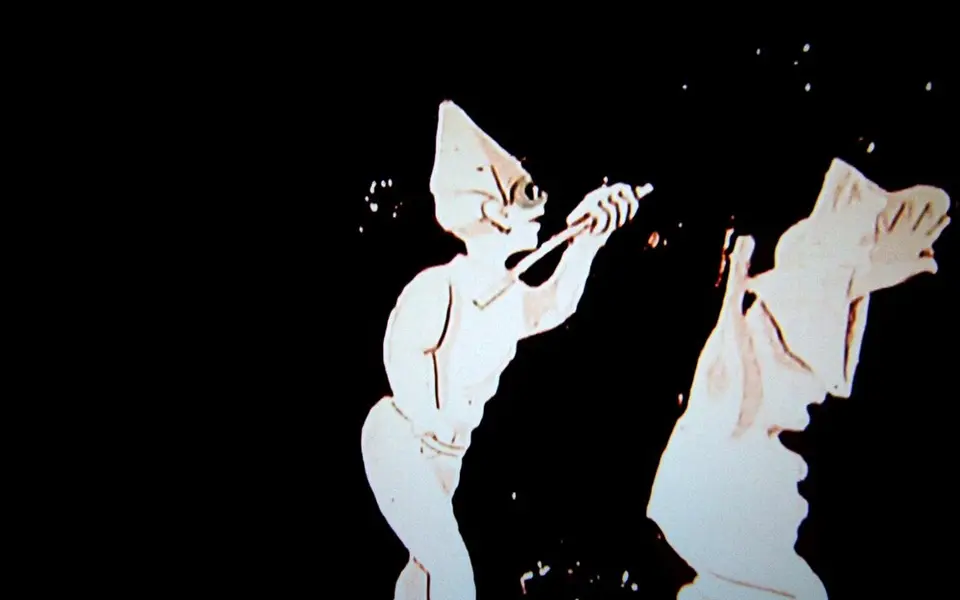
In 1892, three years before the Lumière brothers, Émile Reynaud began projecting hand-painted animated films for paying audiences at the Musée Grévin in Paris.
On October 28, 1892, in the Cabinet Fantastique of the Musée Grévin in Paris, Émile Reynaud gave the first show of his Pantomimes Lumineuses. There were three short films, Pauvre Pierrot, Un bon bock and Le Clown et ses chiens. Gaston Paulin played piano music he had written for them, including a song for Pierrot to serenade Colombine. It was the first public theatrical showing of moving pictures on film, three years before the Lumière brothers' first paid screening.
Reynaud had started with a toy. In 1877 he patented the praxinoscope, an improvement on the zoetrope that used a ring of 12 mirrors to make a short strip of drawings appear to move. He built the first one out of a cookie box. It sold well in the big Paris department stores, and he was able to give up his teaching job.
A toy like that could only repeat the same few poses. His Théâtre Optique, patented in 1888, used a long flexible strip instead, up to 50 meters, carrying 300 to 700 pictures that Reynaud painted by hand on small gelatin plates. Holes between the pictures caught on a turning wheel, the first known use of film perforations. A lantern threw the moving figures onto a background projected from a second lantern. Reynaud worked the strip by hand from behind the screen, repeating movements so that a film could run for more than 10 minutes.
He could not sell the system, so in 1892 he signed a contract with the Musée Grévin. It paid him 500 francs a month and 10 percent of the box office. He had to run every show himself and pay for keeping the equipment working. The painted strips wore out under daily use. He reinforced them with metal rods, and in the end had to make one film again from scratch.
What was Don Draper's birth name in Mad Men?
WhyDon Draper is a borrowed identity. During the Korean War, Dick Whitman took the name of his commanding officer, Lieutenant Don Draper, who was killed in an ambush.
About 500,000 people saw the shows. After 1895 the photographed films of the Lumière brothers drew the crowds away. Reynaud built a version of his machine that could take photographs, but it was overshadowed by their cinematograph. His last show at the Musée Grévin was on March 1, 1900.
Reynaud ended up ruined and forgotten. In despair he smashed his last Théâtre Optique, and he threw most of his films into the Seine. The film producer Léon Gaumont wanted to buy the machine and give it to a museum, but it was already destroyed. Reynaud's son kept two of the films, Pauvre Pierrot and Autour d'une cabine. Reynaud died in 1918.
In 1972 the film archivist Henri Langlois rebuilt a Théâtre Optique for the opening of the Cinémathèque Française's museum. In 2015 UNESCO added Reynaud's moving picture shows to its Memory of the World Register.