 TouchéGet the app
Television's first face belonged to a ventriloquist's dummy
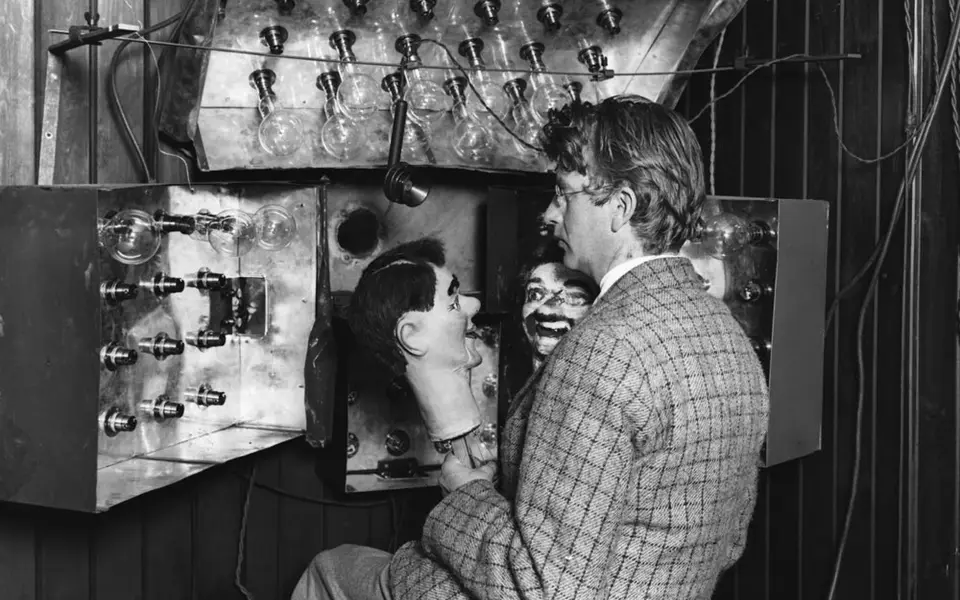
On October 2, 1925, in a workshop in London's Soho, John Logie Baird got his television to show a face in shades of gray.
John Logie Baird, a Scottish engineer, started on television in 1923 in Hastings, on England's south coast, where he had moved for his health. He built his apparatus from things he could buy cheaply, among them an old hatbox, darning needles, bicycle light lenses and a used tea chest. In July 1924 he took a 1,000-volt shock and got away with a burnt hand. His landlord asked him to leave.
In London, looking for publicity, he called at the offices of the Daily Express. According to one of the staff, the news editor ordered them to "get rid of a lunatic" in reception who said he had "a machine for seeing by wireless."
Baird's machine scanned a scene with a spinning disk set with a spiral of lenses. As each lens swept past, it focused light from one strip of the scene onto a light-sensitive cell, which turned brightness into an electric signal. In March 1925 he showed moving silhouettes to the public at Selfridges department store.
Faces were the problem. His cells were not sensitive enough for the low contrast of a human face, and the lamps lighting the subject were so hot that he could not test with a person. So he used the head of a ventriloquist's dummy, whose brightly painted face gave more contrast. Its name, Stooky Bill, comes from a Scots word for plaster.
Name the movie: "What we've got here is failure to communicate".
WhyA prison captain says this after punishing Paul Newman's defiant chain-gang inmate. It was later sampled in a Guns N' Roses song.
On October 2, 1925, in his laboratory at 22 Frith Street in Soho, the dummy's head came through in shades of gray, at five pictures a second. Baird went downstairs and fetched William Taynton, an office boy at a firm in the same building, to see what a human face would look like. Taynton sat in the heat long enough for Baird to get the picture, and became the first person televised in a full range of tones. Asked his opinion, he called the picture "very crude." He was paid half a crown.
On January 26, 1926, Baird showed the system in the same rooms to members of the Royal Institution and a reporter from The Times. It was the first public demonstration of a television system that could show live moving images with shades of gray. Bar Italia now occupies the spot.
Under the lamps, Stooky Bill's hair was singed and his painted face cracked. He is now on display at the Science and Media Museum in Bradford.