 TouchéGet the app
A dying man said only he knew where the stolen van Eyck was
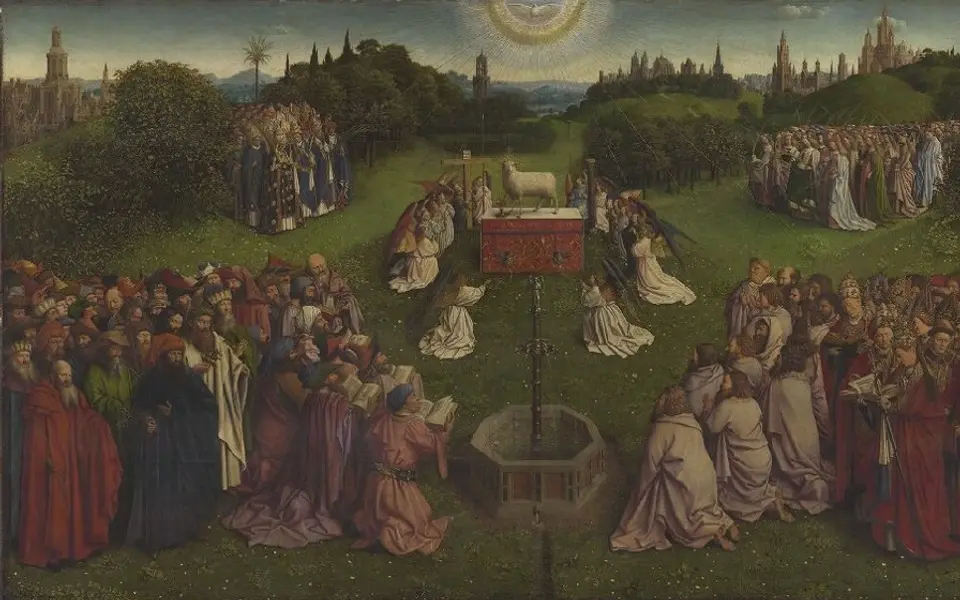
In April 1934 someone took The Just Judges, one panel of the Ghent Altarpiece, and left a note in its place.
During the night of April 10, 1934, someone removed one panel from the Ghent Altarpiece in St. Bavo's Cathedral. The panel, The Just Judges, shows a group of judges on horseback. It had been taken out of its frame with care, and the panels around it were not damaged.
In the empty space the thief left a note in French: "Taken from Germany by the Treaty of Versailles." The altarpiece had been to Germany before. Several of its wings had been sold to the King of Prussia in 1821, and German forces took more panels during World War I. Under the Treaty of Versailles, Germany handed all of them back in 1920.
The next day the Ghent police commissioner, Antoine Luysterborghs, came to the cathedral briefly, then left to look into a theft at a nearby cheese shop.
On April 30 the Bishop of Ghent received a ransom demand for one million Belgian francs. The government refused to pay. It negotiated with the thief instead, on the position that the panel was a national treasure, so the nation's interest came before the diocese's. At least 11 letters went back and forth through October. As a sign of good faith, the thief returned part of what he had taken: a gray painting of John the Baptist that belonged to the same panel.
Which company sold the first instant camera in 1948?
WhyEdwin Land's three-year-old daughter asked why she could not see the picture he had just taken of her. Within an hour he had the idea for an instant camera, and the Land Camera went on sale in 1948.
On November 25, 1934, a man named Arsène Goedertier lay dying in Dendermonde. He told his lawyer, Georges de Vos, that he alone knew where the Mystic Lamb was, using the altarpiece's other name. The details, he said, were in the right-hand drawer of his writing table, in an envelope marked "mutualité." He died that day.
De Vos found carbon copies of the ransom letters and a note that had never been sent. It said the panel rested in a place where no one could take it away without drawing public attention. De Vos waited a month before telling the police. They concluded that Goedertier had been the thief.
The panel has never turned up. Several people have claimed to know where it is, and one search included an X-ray of the whole cathedral to a depth of 33 feet. It is now believed to have been destroyed. In Albert Camus's novel The Fall, the narrator keeps it in his Amsterdam apartment.
In 1945 the Belgian restorer Jef Van der Veken painted a replacement on a cupboard shelf about two centuries old, working from a 16th-century copy. He applied a layer of wax so it would match the old panels around it. He also marked it as a copy in his own way: one of the riders has the face of Leopold III, who was King of the Belgians when the panel was stolen.