 TouchéGet the app
A dead pig set off a 13-year US-British standoff
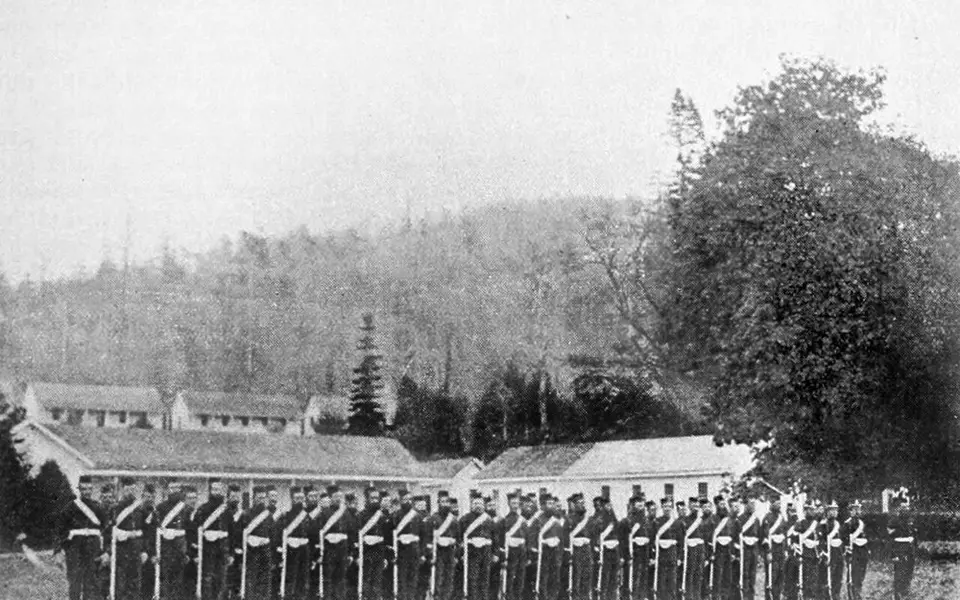
In June 1859 an American farmer on San Juan Island, off the coast of Washington Territory, shot a pig that kept getting into his garden.
On June 15, 1859, Lyman Cutlar, an American farmer on San Juan Island, found a pig rooting in his garden and eating what he had planted. It was not the first time, and he shot it. The pig came from the sheep farm that the British Hudson's Bay Company ran on the island. Cutlar offered to pay for it, the offer was turned down, and British officials threatened to arrest him.
Whether they could arrest anyone there depended on whose island it was, and nobody agreed. The Oregon Treaty of 1846 ran the border between the United States and British territory along the 49th parallel to the middle of the channel that separates the mainland from Vancouver Island, and from there south through the middle of the channel to the Pacific. Between Vancouver Island and the mainland lie the San Juan Islands, with a channel on each side. Britain said the border ran through Rosario Strait, to the east, which made the islands British. The United States said Haro Strait, to the west, which made them American.
Both had moved in. The Hudson's Bay Company ran its sheep farm, and by the summer of 1859 about two dozen American settlers had arrived. After the arrest threat, they asked the US Army for protection.
The army sent Captain George Pickett and a company of infantry, with orders to keep the British from landing. The British sent warships. "We'll make a Bunker Hill of it," Pickett said. He first set up his camp directly under the guns of a British warship, and moved it a few miles north when someone pointed this out.
By August 10 there were 461 American soldiers on the island with 14 cannons. Facing them were five British warships carrying 70 guns and 2,140 men. The governor of Vancouver Island, James Douglas, wanted the Americans removed. When the British admiral in the Pacific, Robert Baynes, arrived, he refused to land troops. He would not, he said, start a war between two great nations "over a squabble about a pig."
Which of these is the oldest?
WhyOxford University. Teaching there goes back to at least 1096. Tenochtitlan was founded in 1325, and the Aztec Empire itself only formed in 1428.
President James Buchanan sent the army's top general, Winfield Scott, to calm things down. He and Douglas agreed that both countries would keep troops on the island, no more than 100 each, until the border was settled. The British camped at the north end, the Americans at the south.
That arrangement lasted 12 years. The two garrisons visited each other's camps to celebrate their national holidays and held sports competitions. Park rangers on the island today tell visitors that the biggest threat to peace was the amount of alcohol available.
In 1871 the two countries agreed to hand the question to an arbitrator, the German emperor Wilhelm I. He passed it to a three-man commission, which met in Geneva for nearly a year. On October 21, 1872, it chose Haro Strait, and the islands became American. The Royal Marines left that November.
Two of the Americans went on to other things. Pickett became a Confederate general and led the charge at Gettysburg that bears his name. Henry Martyn Robert, the young army engineer who built the American fortifications, later wrote Robert's Rules of Order.
The only casualty of the Pig War was the pig.