 TouchéGet the app
A man who made postage cheap sold the first Christmas cards
In 1840 posting a letter anywhere in Britain began to cost one penny. Henry Cole had helped bring that in.
Before 1840, sending a letter in Britain was costly. The price depended on how far the letter went and how many sheets of paper it had, and it was usually more than fourpence. Paying in advance was optional, so the person receiving a letter could be left to pay for it.
In 1840 the Uniform Penny Post changed that. A letter of up to half an ounce now cost one penny between any two places in the country. In the first year, the number of letters sent more than doubled.
Henry Cole, a civil servant, had worked from 1837 to 1840 as an assistant to Rowland Hill, the reformer behind the scheme, and played a key part in bringing it in.
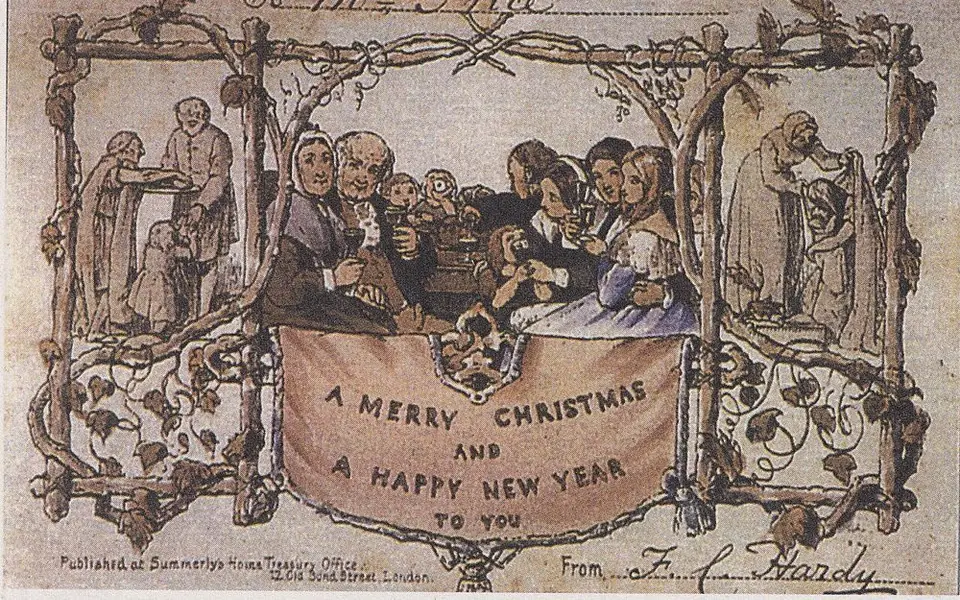
In 1843 Cole commissioned a painter, John Callcott Horsley, to design a card for Christmas. The central picture showed three generations of a family raising their glasses to whoever received the card, with the message "A Merry Christmas and A Happy New Year." The panels on either side showed food and clothing being given to the poor.
Two print runs, 2,050 cards in all, were sold that year at a shilling each. A shilling was twelve pennies, so one card cost twelve times as much as the postage to send it.
What does Apple say to do with an iPhone that got wet?
WhyApple says skip the rice. Tiny grains can get stuck in the phone.
In the middle of the family, a small child is drinking from a glass of wine. The picture reportedly drew some criticism for that.
The early British Christmas cards that followed rarely showed snow or anything religious. They favored flowers, fairies and other fanciful designs that hinted at the coming spring. In 1874 the printer Louis Prang began selling Christmas cards in the United States.
Cole's was the first Christmas card produced for sale, but the oldest known one is much older. In 1611 Michael Maier sent a handmade card to King James I, with the words of his greeting laid out in the shape of a rose. It turned up in the Scottish Record Office in 1979.
In 2001 one of Cole's 1843 cards, which he had sent to his grandmother, sold at auction for £22,500.