 TouchéGet the app
A submarine listening post off Bermuda recorded whale songs
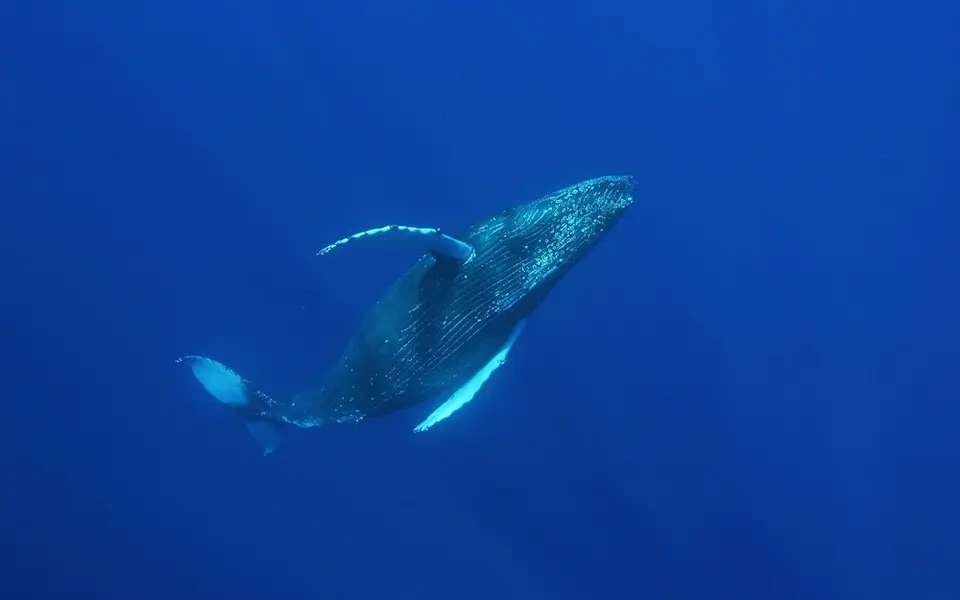
In the 1950s a Navy engineer in Bermuda, listening on underwater microphones for Soviet submarines, kept recording strange moans and wails.
In the late 1950s Frank Watlington, a Bermudian engineer working for the U.S. Navy, worked at a top-secret listening station off Bermuda. Its hydrophones, microphones that work underwater, were there to pick up Soviet submarines. They also picked up eerie moaning and wailing, and Watlington recorded it.
In 1966 the biologist Roger Payne heard about the recordings. He had studied how bats and owls locate things by sound, and he asked for copies.
Payne, working with a colleague, Scott McVay, found that the sounds repeated. Drawn as graphs, they had a clear structure. Single sounds, like notes, made up phrases. A phrase was repeated over and over as a theme, and several themes made a song. The shortest songs ran about six minutes and the longest more than thirty, and a whale could sing its song over and over for up to 24 hours.
The singers were male humpback whales. Payne and his wife at the time, Katharine Payne, found that all the males in one ocean sing the same song. The song changes a little from year to year and never goes back to an earlier version. Katharine Payne later found that the longer songs have something like rhymes, with key passages coming back at intervals.
Which of these animals is a rodent?
WhyBeavers are rodents, and among the biggest in North America. Rabbits look like rodents but belong to a separate group called lagomorphs. Hedgehogs and shrews are neither and are closer to moles.
In 1970 Payne released the recordings as an LP, Songs of the Humpback Whale. It sold more than 100,000 copies, and the money went to a whale conservation fund. That year he testified to the U.S. Department of the Interior, asking for the great whales to be listed as endangered species, and played the songs to the meeting.
Musicians used them. The singer Judy Collins put whale song on an album in 1970, and the composer Alan Hovhaness wrote it into an orchestral piece.
In 1977 a recording of humpbacks from Payne's album went on the Golden Record carried by the Voyager spacecraft, along with recordings of surf, wind and thunder.
In January 1979 National Geographic bound a flexible plastic record of Watlington's recordings, with commentary by Payne, into its magazine. It went out to 10.5 million subscribers, the largest single pressing of any record up to that time.