 TouchéGet the app
From one orchid, Darwin predicted a moth no one had seen
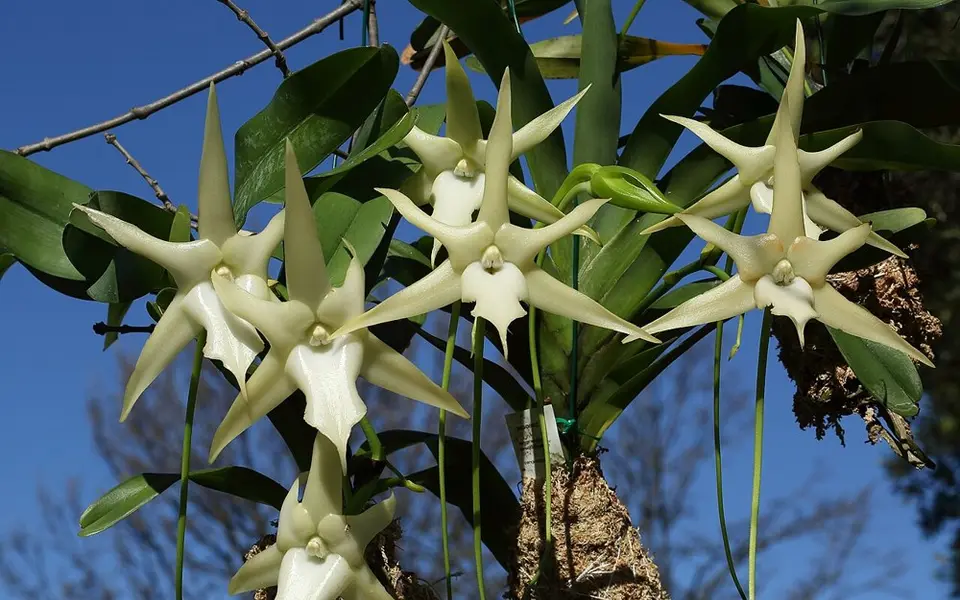
In 1862 Darwin received an orchid from Madagascar whose nectar sat at the bottom of a tube about a foot long.
In January 1862 Charles Darwin received a box of orchids from the horticulturist James Bateman. One was Angraecum sesquipedale, from Madagascar. Behind each waxy, star-shaped flower hung a green spur, a tube about a foot long with nectar at the bottom. "Good Heavens what insect can suck it," Darwin wrote to the botanist Joseph Hooker.
Darwin was writing a book on how insects pollinate orchids, and he experimented. He tried to pull the flower's pollen packets out with needles and bristles and failed. Only when he pushed a cylinder a tenth of an inch across all the way down the spur did the pollen stick to it and come away as he drew it out.
His conclusion, in the book that year, was that Madagascar had a moth with a tongue long enough to reach the bottom of the spur. To get at the nectar, it would have to push its head right up against the flower. The pollen would stick to it, and the moth would carry it to the next orchid.
Darwin and Alfred Russel Wallace suggested how a flower and a moth could end up like this. If a moth's tongue is longer than a flower's spur, the moth can drink without its head touching the pollen, and that flower is not pollinated. Flowers with longer spurs get pollinated more, so spurs get longer. Moths whose tongues cannot reach the nectar get less food, so tongues get longer too.
For some time the idea of a moth with a tongue that long was ridiculed. In 1867 Wallace wrote that such a moth "may be safely predicted," and that naturalists visiting Madagascar should search for it with as much confidence as astronomers had searched for the planet Neptune. He pointed to an African hawk moth, now called Xanthopan morganii, whose tongue was almost long enough.
What is a female pig called?
WhyAn adult female pig is a sow, and a male is a boar. Baby pigs are piglets. Sows build a nest of twigs and leaves before giving birth.
In 1873 William Alexander Forbes asked readers of the journal Nature whether anyone knew of Darwin's moth. The answer that came back was a moth with a tongue about a foot long, found by the naturalist Fritz Müller, but in Brazil. Darwin died in 1882 without hearing of one in Madagascar.
In 1903 the moth experts Walter Rothschild and Karl Jordan described a Madagascan form of Xanthopan morganii with an especially long tongue, and named it praedicta. Their paper did not mention Darwin.
The news traveled slowly. In 1907 another query in Nature asked about the moth, and Wallace replied that he knew of no suitable pollinator in Madagascar.
The moth has since been watched at work. It checks the flower by its scent, backs off more than a foot, unrolls its tongue and flies in. When it pulls the tongue out, the pollen comes with it.