 TouchéGet the app
A five-month-old bird flew 8,400 miles without stopping
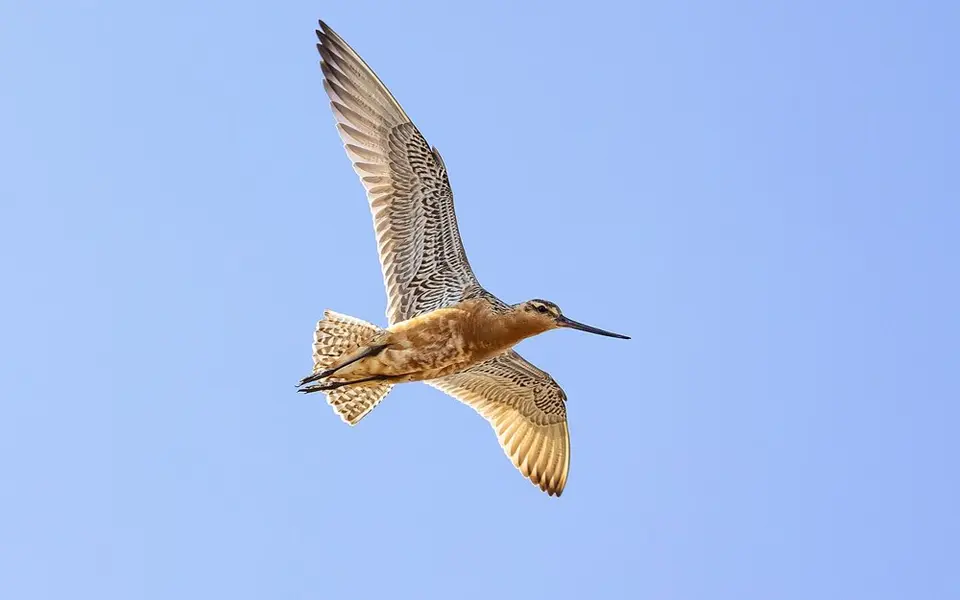
In October 2022 a young bar-tailed godwit carrying a satellite tag left Alaska and came down in Tasmania 11 days later. It never stopped to rest or feed on the way.
Bar-tailed godwits that nest in Alaska spend the northern winter in New Zealand and eastern Australia. To get there they fly straight across the Pacific, about 7,000 miles, without stopping to feed.
They pay for it with fat. These godwits carry the greatest fat loads of any migratory bird studied so far, and to make room for it their digestive organs shrink. Before they leave, more than half a bird's weight can be fat. In New Zealand, they tend to leave early when the winds are favorable, and they seem able to read the weather along the whole route ahead.
Satellite transmitters showed how far they go in one go. Seven godwits in New Zealand were fitted with surgically implanted transmitters and followed north to the Yellow Sea in China. One bird's track came to 6,851 miles, flown in nine days.
What is a narwhal's tusk?
WhyThe tusk is a spiraled canine tooth that grows out through the upper lip. Most tusks belong to males and can grow nearly 10 feet long. Scientists think it may help the whale sense the saltiness of the water.
One of the seven, a female flagged E7, went on from China to Alaska to breed. In August 2007 she left western Alaska and flew for eight days without stopping, to the Piako River near Thames, New Zealand. That was 7,260 miles, a new record. Her whole round trip took 174 days and covered about 18,000 miles, 20 days of it spent flying.
Other godwits have broken her record since. A male flagged 4BBRW set a new nonstop record in 2020, then broke it himself in 2021 with a flight of about 8,100 miles from Alaska to New South Wales.
On October 13, 2022, a juvenile flagged B6 left Alaska. It flew for 11 days and 1 hour and came down in Tasmania, the first time a tagged bird had flown that route. The distance was at least 8,430 miles, a new record. The bird was about five months old, on its first trip south.