 TouchéGet the app
A chess machine kept its secret for 84 years
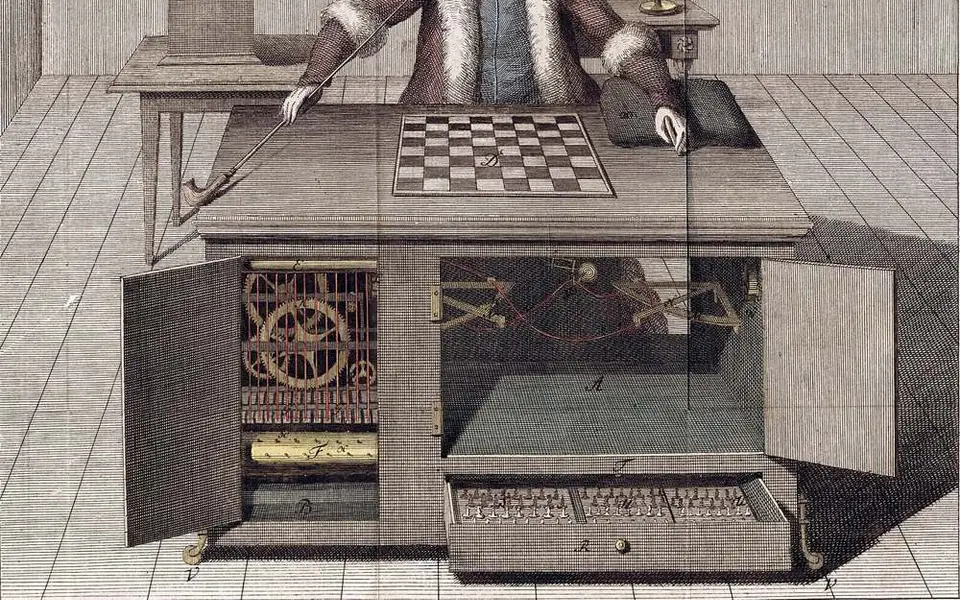
In 1770 Wolfgang von Kempelen showed the court in Vienna a life-size figure in a turban, seated at a cabinet that seemed full of gears. It played chess and usually won.
In 1769 a French illusionist, François Pelletier, performed for Empress Maria Theresa at Schönbrunn Palace in Vienna. Wolfgang von Kempelen, a civil servant who also built machines, promised to return within a year with something better.
He came back in 1770 with a wooden cabinet about three and a half feet long, a chessboard on top. Behind it sat a life-size figure with a black beard, Ottoman robes and a turban. Before each game Kempelen opened the doors and the drawer one by one. One side was packed with gears, and with the back doors open too, the audience could see straight through. Then the figure played, and it usually won within half an hour. A visitor named Louis Dutens once tried to move his queen like a knight. The Turk picked her up and put her back.
The player was a chess master hidden inside. The gears reached only a third of the way back. He sat on a sliding seat and shifted from side to side as the doors were opened, while dummy machinery slid into the space he had left. Each piece had a magnet in its base, which pulled on a small magnet hanging under its square, so he could follow the game from below. Working by candlelight, he moved the Turk's arm through a linkage from a pegboard chessboard. Kempelen invited spectators to bring magnets and test the machine. The magnets inside were placed so that outside ones could not move them.
Kempelen kept it out of sight. He called it a trifle, preferred to work on a speaking machine, and took the Turk apart. In 1781 Emperor Joseph II ordered him to rebuild it for a state visit by Grand Duke Paul of Russia, and its success there led to a tour. In Paris it lost to François-André Philidor, ranked among the best players of the day, who called it his most tiring game ever. It also played Benjamin Franklin, then the American ambassador to France.
What does it mean to "respawn" in a video game?
WhyBattle royale games mostly take it away. Contestants typically get one life, and players who die are rarely allowed to respawn. Elsewhere, dying can cost lives, score or resources.
Kempelen died in 1804, and his son sold the Turk to Johann Mälzel, a Bavarian inventor and showman, for half the price Kempelen had once asked. In 1809 it played Napoleon at Schönbrunn. The details of that game vary from one account to the next. The Turk won. Mälzel later added a voice box so it could say "Échec!"
In 1826 Mälzel opened a show in New York and kept the Turk touring the United States into the 1830s. In Baltimore it lost a game to Charles Carroll, an 89-year-old signer of the Declaration of Independence. In 1836 Edgar Allan Poe, who had seen it in Richmond, published an essay arguing that a person was working it. A machine would play perfectly, he reasoned, and the Turk sometimes made mistakes. Many of his other guesses about the mechanism were wrong.
In 1838 its operator, William Schlumberger, died of yellow fever in Havana, and Mälzel died aboard ship a few months later. A Philadelphia physician, John Kearsley Mitchell, restored the Turk and placed it in a museum, where it ended up forgotten in a back corner. On July 5, 1854, a fire spread from a nearby theater and destroyed it. In 1857 Mitchell's son published the first full account of how it had worked. The chessboard had been stored separately, and it survived.