 TouchéGet the app
The game that named a genre is set in a real Kentucky cave
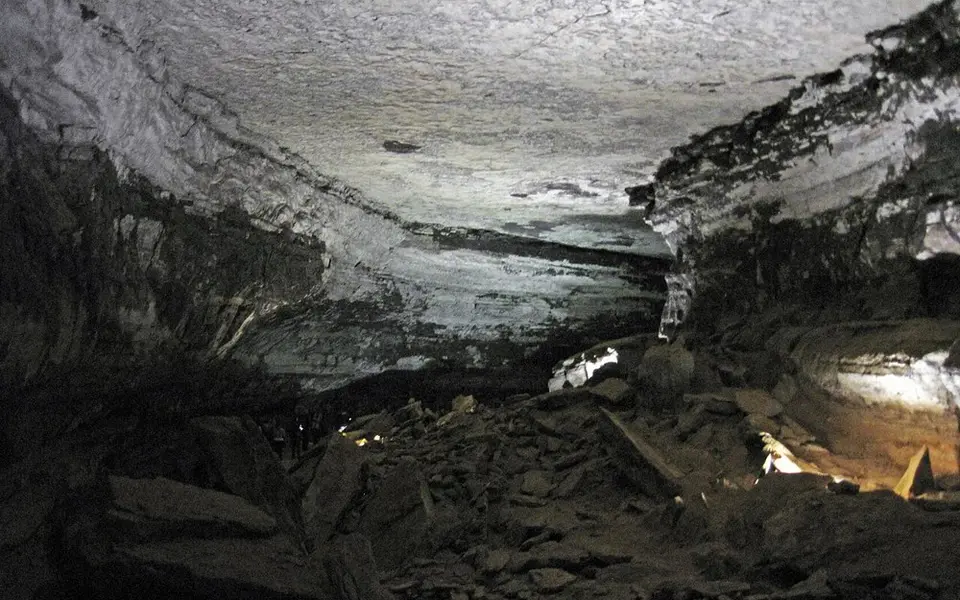
Will Crowther and his wife Pat, both programmers, spent years mapping Kentucky's Mammoth Cave.
Will and Pat Crowther were both programmers and both cavers. In the 1960s and early 1970s they explored Mammoth Cave in Kentucky, the longest known cave system in the world. In September 1972 Pat played a key part in the expedition that found the link between Mammoth Cave and the neighboring Flint Ridge system.
They mapped it too. At home they typed the survey figures from what they called "muddy little books" into a terminal connected to a computer at BBN, the company where Will worked. Their program turned the figures into instructions for a plotter, which drew some of the earliest computer-made maps of caves.
In 1975, after the couple divorced, Will stopped caving with the group. In his own words, the caving "had become awkward," and he was missing his two daughters, Sandy and Laura. So on BBN's computer he began writing a game that would be "a re-creation in fantasy of my caving," and also a game for the kids.
He worked from his memories and from a 1975 map of a section of the cave called Bedquilt. He added elements of the Dungeons & Dragons games he played with friends, and the player explored the cave in search of treasure. Crowther wanted the game to be friendly to people who knew nothing about computers. The player typed one- or two-word commands in plain English, and the program answered by describing what happened. "My kids thought it was a lot of fun," he wrote.
How much do you collect for passing GO in Monopoly?
WhyUnder the official rules Free Parking pays nothing, so the jackpot many families play is a house rule. Passing Go pays $200, and everyone starts with $1,500.
When it was done he showed it to his co-workers, decided it was finished, and left for a month's vacation. Crowther's job at BBN was building the ARPANET, the network that became the internet, and the computer holding his game was on it. While he was away, people found the game and copied it to computers at other companies and universities.
One of them was Don Woods, a graduate student at Stanford. To get the source code, he emailed "crowther" at every site on the network. Woods added a dragon, a pirate who steals your treasure, new puzzles and a score. He also let system managers block the game during working hours. His 1977 version is the one most people played, and the team that wrote Zork has said it was their inspiration.
Cavers who played the game have said that much of Crowther's part matches the real Bedquilt, with a few passages left out to make it work as a game. Woods's additions do not, because he had never been there. Crowther's daughters remember that when a puzzle frustrated them, their father would tell them it was one of Woods's.
Crowther never handed out his own source code, and for decades it was thought to be lost. In 2005 a copy turned up in an archive of Woods's old student account at Stanford's artificial intelligence lab.