 TouchéGet the app
Two teams put the same space game in a coin box in 1971
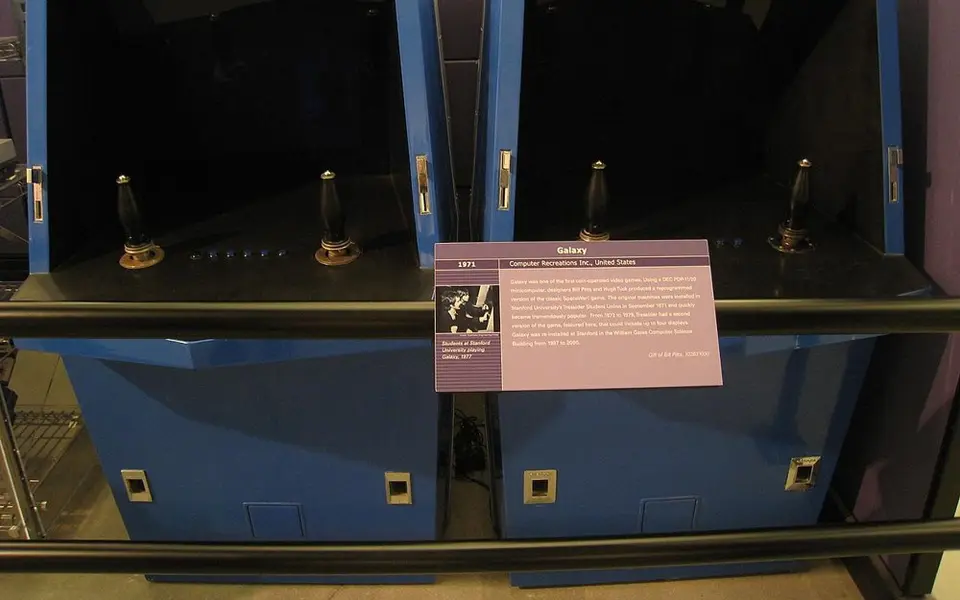
Bill Pitts and Hugh Tuck wired a $14,000 minicomputer to a walnut console in Stanford's student union and charged 10 cents a game.
In 1966 a Stanford student named Bill Pitts, who liked to explore the campus steam tunnels, broke into a building and found the university's artificial intelligence lab and its computer. He talked the head of the project into letting him use it after hours. Soon he had stopped going to classes and was spending his nights there playing Spacewar!, a two-player game from MIT. Two ships fight around a star whose gravity pulls on both.
His usual opponent was a friend from high school, Hugh Tuck. During one game Tuck remarked that a coin-operated version would be a hit. No computer that could run it was cheap enough. Then, in 1971, Pitts learned about a new minicomputer, the PDP-11, which sold for about $14,000. An arcade game usually cost around $1,000, but the two decided it was cheap enough for a test machine.
They spent about $20,000 on it. Pitts built the electronics and wrote the program. Tuck, a mechanical engineer, designed a walnut console with seats. The coin slots came from a jukebox maker, and the joysticks from a military surplus store, left over from B-52 bomber controls. Because of anti-war feeling at the time, they renamed the game Galaxy Game.
In August 1971, with the work well along, they got a call from Nolan Bushnell. He and a colleague, Ted Dabney, were building a coin-operated Spacewar too. They had started with a $4,000 Data General Nova and found it too slow. So they dropped the computer altogether and designed circuits that could run this one game and nothing else. To fit the cheaper hardware they cut the game down to one player against two computer-controlled ships, with no star.
Who is the main villain in the Super Mario games?
WhyIn a 2012 interview Miyamoto said Bowser's only child is Bowser Jr., not the seven Koopalings, and that nobody knows who the mother is. Jr. first appeared in Super Mario Sunshine in 2002.
The two pairs met. Bushnell and Dabney were relieved, and a little disappointed, to find that Stanford's team had no trick for making a real computer pay for itself. Pitts and Tuck admired the hardware and thought the game a pale imitation of Spacewar.
Bushnell's machine, Computer Space, was tested first, in a bar near Stanford, where it did well. Galaxy Game opened in the Tresidder student union in November. The console sat on the second floor, connected by a 100-foot cable to the computer in the attic. A game cost 10 cents, or a quarter for three, and the winner played the next one free. Pitts said people stood ten deep to watch. Computer Space went on sale, but in ordinary bars the customers found it confusing. Bushnell later called it "a little too complicated for the guy with the beer in the bar."
Pitts and Tuck spent $65,000 in all, including a second, bigger version, and never found a way to sell the game. Pitts later said they had cared about the engineering while Bushnell cared about the business. In June 1972 Bushnell and Dabney left Nutting, the company that made Computer Space, and started Atari.
Galaxy Game stayed in the student union until 1979, when its display processor gave out. It was restored in 1997 and moved to the Computer History Museum in 2000. In the mid-1970s Pitts and Tuck had hired a 13-year-old, Jonathan Rosenberg, to keep the machine clean. He later became a senior vice president at Google, and in 2010 the museum lent the game to Google's headquarters at Pitts's request. It has since gone back to the museum, where visitors can play it.