 TouchéGet the app
Trinidad's steel drum grew out of a colonial ban on drums
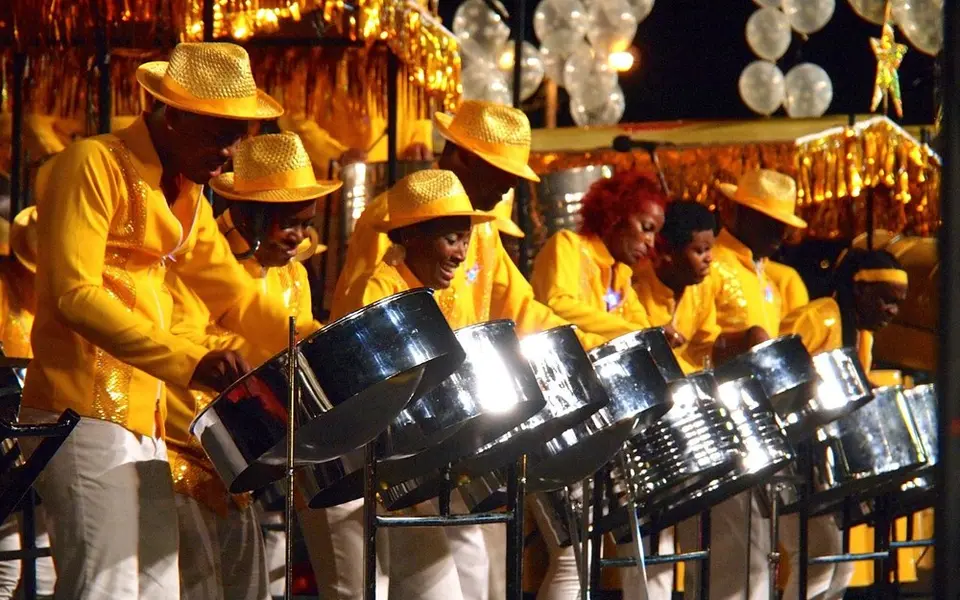
After riots at Trinidad's carnival in 1881, the colonial authorities banned drumming.
In 1881 the Canboulay processions at Trinidad's carnival turned into riots between revelers and the police. Canboulay, from the French for "burnt cane," had begun as a harvest festival with drumming, singing and dancing. After slavery ended in 1834, it became the festival of freed slaves, who were shut out of the colonial elite's carnival.
The colonial government responded by banning drumming in the 1880s, and stick fighting soon after.
In the 1890s the bands found a substitute called tamboo bamboo. Its name comes from the French word for drum, tambour. Dry, hollow bamboo was cut to different lengths for different pitches. The bass, called the boom, was about five feet long and stamped on the ground. Shorter pieces were knocked end to end or struck with a stick, and a gin bottle was played with a spoon. In time the bamboo was banned too.
By the mid-1930s bits of metal had crept in. A car's brake hub, called the iron, replaced the bottle and spoon. A biscuit tin took over from the bass bamboo. In 1937 the players of Laventille came out with a whole orchestra of frying pans, dustbin lids and oil drums.
Which band released the 1969 rock opera Tommy?
WhyPete Townshend wrote "Pinball Wizard" to win over a critic. Nik Cohn, a pinball fan, was going to review the album for The New York Times, and Townshend wanted him to like it.
In 1939 the first all-steel band, Alexander's Ragtime Band, appeared. One of its members was Ellie Mannette, aged 11. He is credited as the first to make a pan from a 55-gallon oil drum instead of a biscuit tin. He also sank the drum's top into a bowl, which left more room for notes and kept them apart. At the time steel bands had a reputation for violence, and women were kept out of them.
In 1951 players from several bands went to the Festival of Britain as the Trinidad All Steel Percussion Orchestra, with Mannette as a member and tuner. It was the first steel band whose instruments were all made from oil drums.
On a modern pan each note is a hammered patch of the steel, and the bigger the patch, the lower the note. It has no skin, so it is classed as an idiophone rather than a drum. In 1992 Trinidad and Tobago declared the steelpan its national instrument, and it is on the country's coat of arms.