 TouchéGet the app
Before microphones, some violins came with a metal horn
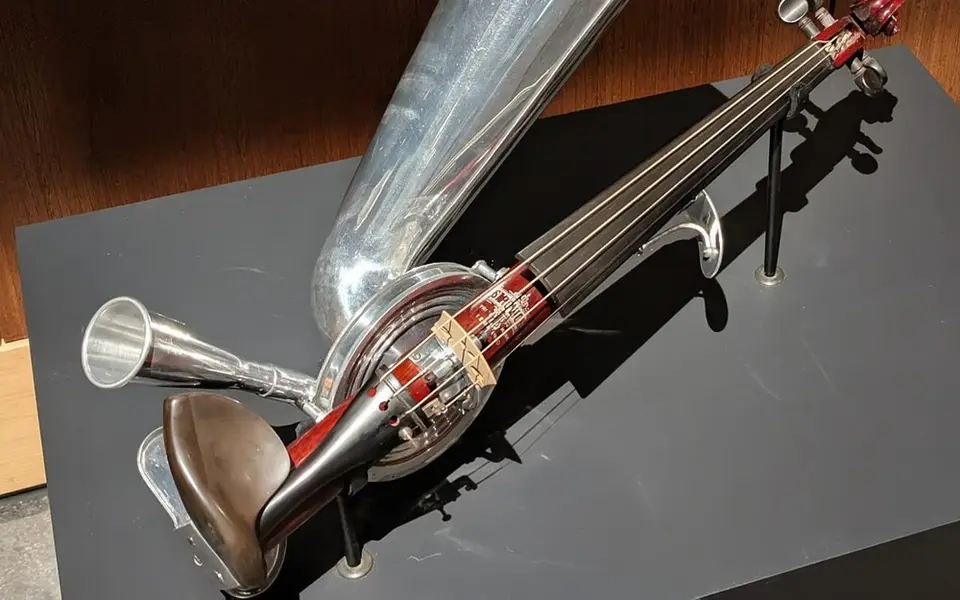
Early records were made by sound alone: musicians played into a big horn, and an ordinary violin recorded poorly.
Before microphones, records were made acoustically. Musicians played into a large horn, which carried the sound to a thin diaphragm, and the diaphragm moved the needle that cut the record. It was not very sensitive. A singer almost had to put their face into the horn.
Loud instruments had to stand back. When King Oliver's band recorded in 1923, the young Louis Armstrong was playing second cornet. He was so loud that he was moved to a corner of the room, away from the horn.
The violin had the opposite problem. Its sound was hard to get onto a disc.
Augustus Stroh had been experimenting with sound for years. He was born in Frankfurt in 1828 and trained with a clockmaker. In 1851 he came to London for the Great Exhibition and stayed. He built telegraph instruments with Charles Wheatstone. He also improved on Edison's phonograph and built an instrument meant to imitate the human voice.
The octobass is a giant version of which instrument?
WhyThe octobass is about eleven feet long, so no player can reach the top of its fingerboard. Instead, levers and pedals clamp the strings at set points. Only one known work calls for it: a Gounod mass from 1855.
In 1899, at 70, he applied for a patent on a new kind of violin. It had strings, a neck and a bridge, but no wooden sound box. The bridge passed the vibrations to a metal diaphragm, like the one in a phonograph. A metal horn on the end of the instrument sent the sound out in one direction. The player could point it at an audience or straight into the recording horn. A second, smaller horn could sit by the player's ear, so he could hear what he was playing.
It was much louder than a wooden violin, and it became common in recording studios. It was not cheap. In 1911 a London dealer sold it for nine or twelve guineas, when a decent factory violin cost two. It was also advertised for small theaters and music halls. In Buenos Aires in the 1920s, the tango bandleader Julio de Caro played one on stage, and locals called it the cornet violin.
In the second half of the 1920s record companies switched to electric microphones, and the horn was no longer needed. Stroh violins became rarer.
A similar instrument, the Romanian horn violin, is still played in the folk music of the Bihor region of Romania.