 TouchéGet the app
The Pantheon's dome has stood 1,900 years without steel
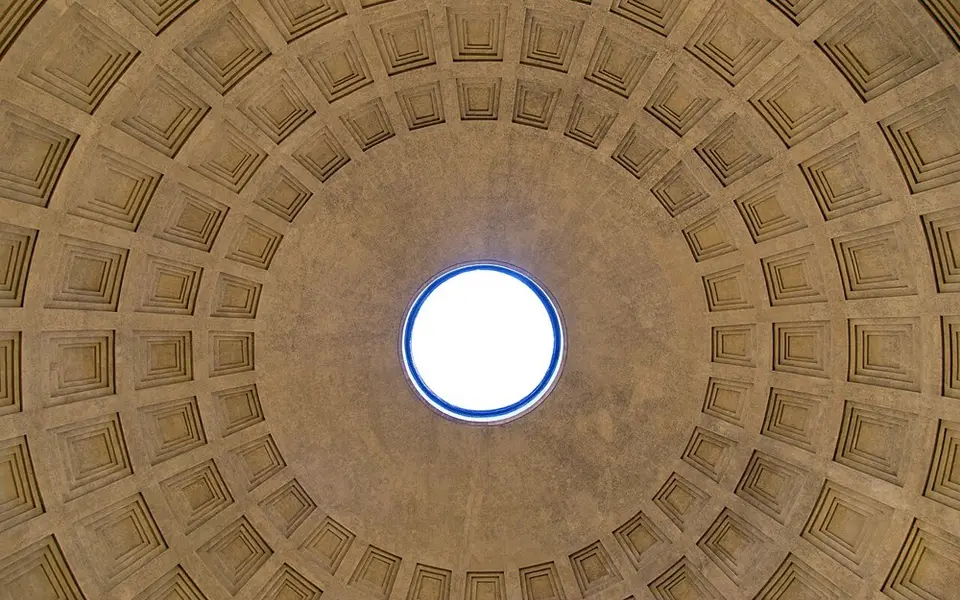
The dome of the Pantheon in Rome is 142 feet across and has no steel inside it. It was finished around AD 125 and is still the largest unreinforced concrete dome in the world.
The Pantheon in Rome was finished under the emperor Hadrian, around AD 125. Its dome is 142 feet across, and the top of the dome is 142 feet above the floor, so a ball that size would fit inside the room exactly. The dome was more than twice as wide as any dome known before it. It was the largest dome in the world for more than a thousand years, and it is still the largest ever built of concrete with no steel in it.
Roman concrete was strong when squeezed and weak when stretched. A computer model of the Pantheon found that its dome is stretched hardest where it meets the wall below. Roman builders did not pour their concrete. They laid it by hand, in horizontal layers against a wooden frame, a day's work at a time. That let them change the mix as they went.
In the lowest part of the dome, the stone chunks in the concrete are travertine. Higher up the builders switched to terracotta tiles, and at the top to tufa and pumice, porous stones that weigh far less. The concrete at the top of the dome is about 40 percent lighter than the concrete in the foundations. Two researchers who modeled the dome estimated that with heavy concrete all the way up, the stresses in it would be about 80 percent higher.
The dome also gets thinner as it rises, from about 21 feet thick at the bottom to about 4 feet around the top.
Which civil rights leader gave the "I Have a Dream" speech?
WhyThe best-known part of the speech was not in the script. Near the end, the gospel singer Mahalia Jackson called out, "Tell 'em about the dream, Martin!" and King began improvising on the theme.
At the very top, where a dome is weakest, there is no dome at all. The opening there, the oculus, is 30 feet across, and its edge is a ring of wedge-shaped blocks like the stones of an arch. The oculus has never been covered. Rain falls straight in, and the floor slopes about a foot toward drains.
Cracks running up the dome seem to have opened very early. Since then it has worked as a set of arches that share one keystone at the top. The builders may have expected this. On the outside, the lower part of the dome is wrapped in stepped rings that press down on it, and a single solid shell would not have needed them.
The dome also lasted because the building never stood empty. In 609 the emperor Phocas gave it to Pope Boniface IV, who made it a church. That spared it the worst of the stripping that most of ancient Rome's buildings went through in the following centuries.
It did not save the roof. In 663 the emperor Constans II took the bronze tiles off the dome and shipped them to Constantinople. The dome stood bare for nearly a century, until Pope Gregory III had it covered with sheets of lead.