 TouchéGet the app
A diver saved Winchester Cathedral, working in the dark
In 1905 the cathedral was sinking into soft ground, with cracks a child could crawl into. Its repair trenches kept flooding, and pumping them made it sink faster.
By the summer of 1905 Winchester Cathedral was coming apart. Some cracks in its walls were wide enough for a small child to crawl into, the walls bulged and leaned, and stone was falling. The architect Thomas Jackson surveyed it and found the whole building tilting to the south-east and sinking.
Jackson brought in the engineer Francis Fox, and they dug down beside the east end to find out why. The Normans had built the cathedral on a raft of beech trunks, a layer about 15 inches thick, laid over soft peat. Some of the trunks had rotted and collapsed. Below the peat, 16 to 24 feet under the floor, lay firm gravel. The plan was to dig trenches down to the gravel and build them up with concrete and brick, so the walls would rest on something solid.
The moment the diggers broke through the peat, water rushed in. The peat had been acting as a seal, and the trenches filled from the nearby River Itchen. Jackson had them pumped, but the pumps began drawing up chalk silt from under the foundations, and in the spring of 1906 the cathedral started sinking faster. Fox stopped the pumping. The trenches had to be sealed from underneath the water before they could be drained.
Fox sent to London for William Walker, the most experienced diver at the diving firm Siebe Gorman. Walker arrived on April 5, 1906. In a suit that weighed 200 pounds dry, he went down into trenches up to 20 feet deep. The water was so thick with sediment that no light reached him, so he worked by feel, clearing out peat and laying bags of concrete on the gravel to plug the water rising from below. He did this about six hours a day.
Which building has the address 1600 Pennsylvania Avenue?
WhyDublin gave Washington its blueprint. An Irish-born architect, James Hoban, won a design contest for the president's house in 1792, and he modeled it on Leinster House, which now holds Ireland's parliament.
He kept at it until 1911 and dived under most of the building. In all he laid more than 25,000 bags of concrete. Late in the job he cycled home to South Norwood at weekends, 70 miles, and came back by train on Monday. When he was done, the water could be pumped out safely, and ordinary bricklayers restored the damaged walls in the dry.
On St. Swithun's Day, July 15, 1912, the Archbishop of Canterbury led a service of thanksgiving in the cathedral. King George V gave Walker a silver rose bowl. Newspapers pointed out that the two had met before: Walker had taught the king to dive when the king was a naval cadet. Walker was later made a Member of the Royal Victorian Order.
He died in the flu epidemic of 1918. His grave reads: "The diver who with his own hands saved Winchester Cathedral."
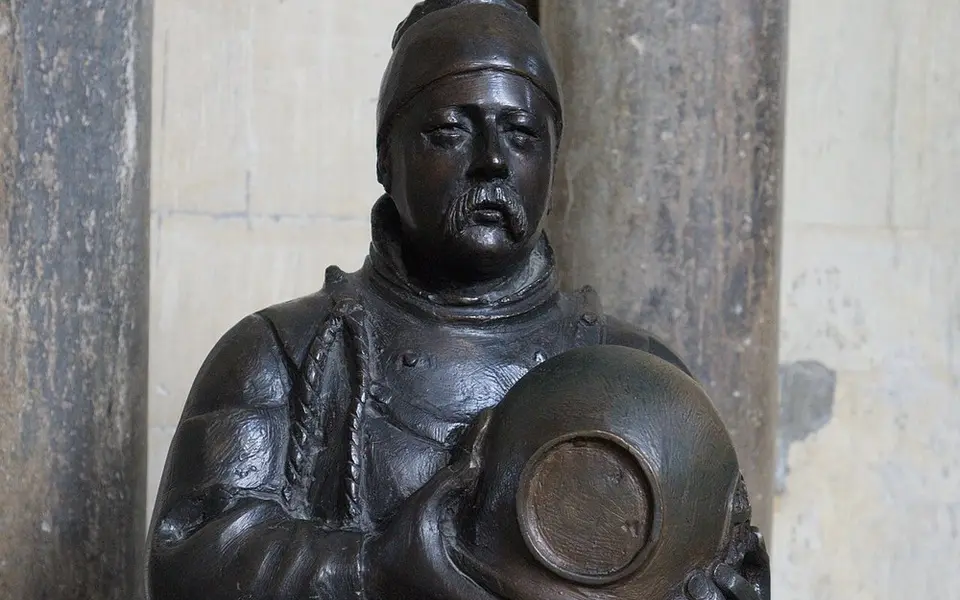
The cathedral has a small statue of him. Until May 2001 that statue was modeled, by mistake, on the engineer Francis Fox.