 TouchéGet the app
The lowest shore on Earth drops more than three feet a year
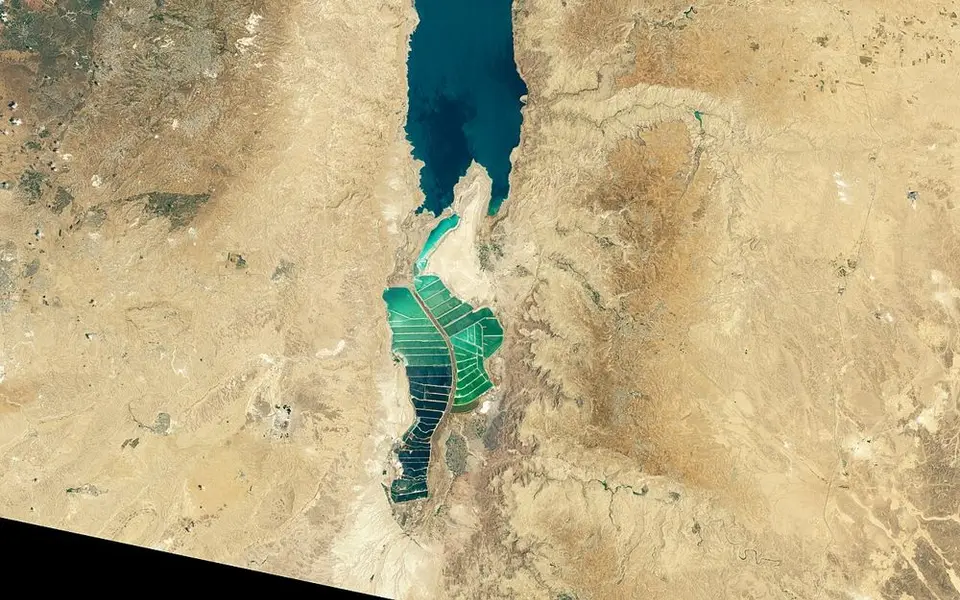
The Dead Sea's shore is the lowest dry land on Earth, and it keeps getting lower.
The Dead Sea has been measured continuously since 1930. That year its surface lay 1,280 feet below sea level and covered 410 square miles. By 2025 the surface was about 1,440 feet below sea level and the lake covered about 234 square miles. In recent years it has been falling by more than three feet a year.
The lake has no outlet. Water comes in from the Jordan River, from smaller streams and springs, and as rain, and it leaves by evaporating. When less comes in, the level drops.
The Jordan River used to be its main source. Since the 1960s its water has been taken for irrigation and drinking. Israel's National Water Carrier, completed in 1964, draws from the Sea of Galilee, which the Jordan flows through on its way south. On the Jordanian side, the Wadi Hassa stream is now used up entirely before it arrives. Up to 95 percent of the Jordan's water is diverted, and the river now supplies about a sixth of what reaches the Dead Sea, less than the rain does.
The whole southern end has been diked off into evaporation pans by two potash companies, Israel's Dead Sea Works and Jordan's Arab Potash. A long dike runs down the middle, roughly along the border between the two countries. Water reaches the pans through a canal that Dead Sea Works maintains.
How many stars are on the flag of the United States?
WhyOne star for each state, so the count has changed 27 times since 1777. The current 50-star version arrived in 1960, after Hawaii joined. The 13 stripes never change, one for each original colony.
As the lake drops, so does the groundwater around it, and fresh water flushes out the brine that used to fill layers underground. The fresh water dissolves the salt there, and the ground over the hollows caves in. That is the likely cause of the large sinkholes along the western shore. Most of the beach resorts on that side of the northern basin have had to close.
The idea of bringing in water from the sea is old. British officers first suggested a canal in the mid-1800s, as a way around the French-built Suez Canal. They had not realized how far below sea level the Dead Sea lies.
In December 2013 Israel, Jordan and the Palestinian Authority signed an agreement for a pipeline of about 110 miles from the Red Sea. It would have turned seawater into drinking water and sent the leftover brine to the Dead Sea. In June 2021 the project was abandoned. It had never broken ground.